
FII and DII Data in August 2025: Who Drove the Markets?
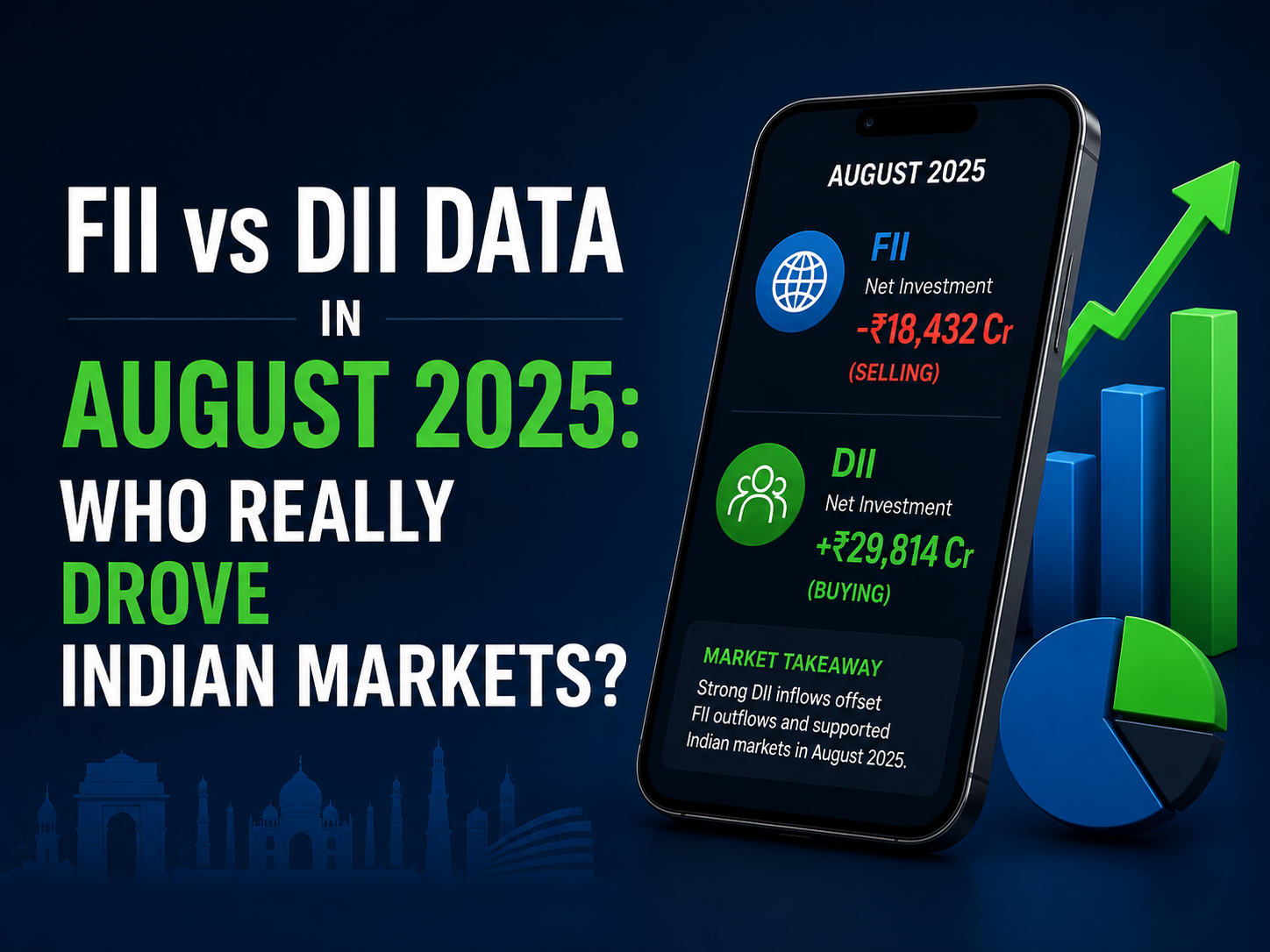
FII and DII Data in August 2025: Who Drove the Markets?
August 2025 turned into a tug-of-war between two very different sets of investors. Foreign Institutional Investors (FIIs) pulled money out of Indian equities at a rapid clip, while Domestic Institutional Investors (DIIs) did the exact opposite — buying aggressively into every dip. The result was a market that stayed far more stable than the headline FII selling numbers would suggest, and it's a pattern worth understanding if you're trying to read where Indian equities go next.
This piece breaks down the FII and DII data for August 2025, what drove the divergence, and what it tells traders and investors about the current phase of the market.
FII and DII Data for August 2025: The Numbers
FII (Foreign Institutional Investors) — Month Till Date
- Gross Buy: ₹268,077.36 crore
- Gross Sell: ₹314,980.28 crore
- Net Outflow: ₹46,902.92 crore
DII (Domestic Institutional Investors) — Month Till Date
- Gross Buy: ₹293,563.09 crore
- Gross Sell: ₹198,734.54 crore
- Net Inflow: ₹94,828.55 crore
Put simply: DII buying was more than double the size of FII selling in August 2025. That gap is the single biggest reason Indian indices didn't see the kind of correction that heavy foreign outflows usually trigger.
Why FIIs Turned Net Sellers in August 2025
Foreign institutional selling wasn't specific to India — it was part of a broader shift in how global funds were positioning themselves. A few factors stood out:
Global trade tensions. Renewed U.S. tariff actions and trade friction pushed foreign funds toward a more risk-off stance across emerging markets, not just India.
Dollar strength and bond yields. A firmer U.S. dollar and elevated bond yields made U.S. fixed-income assets more attractive relative to emerging-market equities, pulling capital back toward developed markets.
Global growth concerns. Uncertainty around the pace of global economic growth added to the caution, with FIIs trimming exposure to cyclical and export-dependent sectors.
The sectors that felt the most pressure were the ones most tied to global demand and currency movements — IT services, pharmaceuticals, and chemicals — all of which have significant export revenue exposure.
Why DIIs Kept Buying Through the Outflows
While FIIs were heading for the exit, domestic mutual funds, LIC, and insurance companies were doing the opposite — treating the FII-driven dips as buying opportunities.
This wasn't random buying. DII flows were concentrated in banking, infrastructure, and consumer-facing sectors — segments more tied to India's domestic growth story than to global trade cycles. That sector preference matters: it shows DIIs were making a conviction call on India's internal demand rather than simply absorbing whatever FIIs were selling.
This also reflects a structural shift that's been building for a few years now — the steady rise of SIP inflows and retail participation through mutual funds has given DIIs a much larger, more consistent pool of capital to deploy, regardless of what foreign flows are doing in any given month.
How This Played Out on Nifty and Sensex
The net effect of this FII-DII tug of war showed up in a few clear ways:
- Volatility stayed elevated through the month as heavy FII selling created intraday swings.
- Nifty and Sensex avoided a sharp correction — DII buying absorbed most of the selling pressure that would otherwise have dragged the indices down.
- Midcaps and smallcaps held up well, supported by continued retail participation and mutual fund inflows rather than large-cap-focused FII money.
- The rupee saw some pressure from FII outflows, though DII support limited how far the currency weakness extended.
What This Means Going Into September and Beyond
If FII selling continues into the next month on the back of the same global factors — tariffs, dollar strength, and growth concerns — Indian markets could stay range-bound rather than trending strongly in either direction.
That said, the underlying supports remain intact: India's domestic growth trajectory, resilient corporate earnings, and steadily rising retail participation through SIPs are all working in the market's favor. The August 2025 data makes one thing clear — DIIs are no longer just a secondary source of liquidity. They're increasingly the factor that determines whether foreign selling turns into a correction or gets absorbed.
The Bottom Line
In August 2025, FIIs pulled out close to ₹47,000 crore from Indian equities, while DIIs poured in nearly ₹95,000 crore — more than offsetting the outflow. This isn't a one-off. It reflects a broader trend of Indian markets becoming less dependent on foreign capital and more driven by domestic institutional and retail participation.
For traders and investors, the takeaway is simple: understanding FII-DII data isn't just about tracking one number. It's about reading which side has conviction, in which sectors, and what that says about where the market is likely headed next.
Want to learn how to read FII-DII data, sector rotation, and market flows like a professional analyst?
Explore Empirical F&M Academy's Equity Research and Valuation and Fundamental Analysis courses to build a structured framework for reading institutional flows and market direction.
Track more real-time market movements on our Market Update page, or browse our Blog for more market analysis like this.
FAQs
Q1. What is the difference between FII and DII in the stock market?
FIIs (Foreign Institutional Investors) are overseas entities investing in Indian markets, while DIIs (Domestic Institutional Investors) are India-based entities like mutual funds, insurance companies, and banks investing domestic capital.
Q2. Why did FIIs sell Indian equities in August 2025?
FII selling in August 2025 was driven largely by global factors — U.S. tariff tensions, a stronger dollar, higher bond yields, and concerns over global growth — which made emerging market equities like India relatively less attractive.
Q3. Did DII buying fully offset FII selling in August 2025?
Yes. DII net inflows of ₹94,828.55 crore were more than double the FII net outflow of ₹46,902.92 crore, which helped keep Nifty and Sensex from correcting sharply.
Q4. Which sectors were most affected by FII selling in August 2025?
Export-oriented and globally linked sectors — particularly IT, pharmaceuticals, and chemicals — saw the most pressure from FII outflows.
This content is for educational and knowledge purposes only and should not be considered as investment or Trading advice. Please consult a certified financial advisor before making any investment or Trading decisions.
Latest Course





Latest posts





Our Recent FAQS
Frequently Asked Question &
Answers Here
Q1. What are FIIs and DIIs?
FIIs are foreign investors (like hedge funds, pension funds, investment banks) who invest in Indian stocks.
DIIs are domestic players (like mutual funds, LIC, insurance companies, pension funds) who invest in the local markets.
Q2. Why do FIIs sell heavily sometimes?
Q3. How do DIIs impact the market?
Q4. What does August 2025 data mean for investors?
Copyright © By Empirical F&M Academy. Design & Developed by Techno Duniya