
Stock Market vs Mutual Funds: A Beginner's Guide

Stock Market vs Mutual Funds: A Beginner's Guide
If you are planning to start your investment journey, one of the most common questions is whether to invest in the stock market or Mutual Funds.
Many people in India want to grow their savings but feel confused about where to begin. Some are attracted to the fast returns of the stock market, while others prefer the stability of mutual funds.
In this detailed beginner’s guide, we will explain:
- What is the stock market
- What are mutual funds
- Difference between the stock market and mutual funds
- Risk, returns, and management
- Which option is better for beginners in India
Let’s break it down in simple and practical language.
What Is the Stock Market?
The stock market is a marketplace where shares of publicly listed companies are bought and sold. When you purchase a share, you become a partial owner of that company.
For example:
- If the company earns profits and grows, the value of your shares may increase.
- If the company performs poorly, the share price may fall.
How the Stock Market Works in India
In India, shares are traded mainly on:
- NSE (National Stock Exchange)
- BSE (Bombay Stock Exchange)
To start investing, you need:
- A Demat account
- A trading account
- PAN and KYC verification
Many beginners search for how to start investing in the stock market in India because direct stock investing offers high return potential. However, it also comes with higher risk and volatility.
Stock prices change daily based on:
- Company performance
- Economic conditions
- Government policies
- Market sentiment
This is why understanding stock market basics for beginners is very important before investing.
What Are Mutual Funds?
Mutual funds are investment vehicles where money from multiple investors is pooled together. A professional fund manager uses this pooled money to invest in stocks, bonds, or other securities.
Instead of investing in one company, your money is spread across many companies. This is called diversification.
Diversification reduces the impact of losses from one company because your investment is distributed.
Types of Mutual Funds in India
Understanding types of mutual funds in India helps beginners choose wisely:
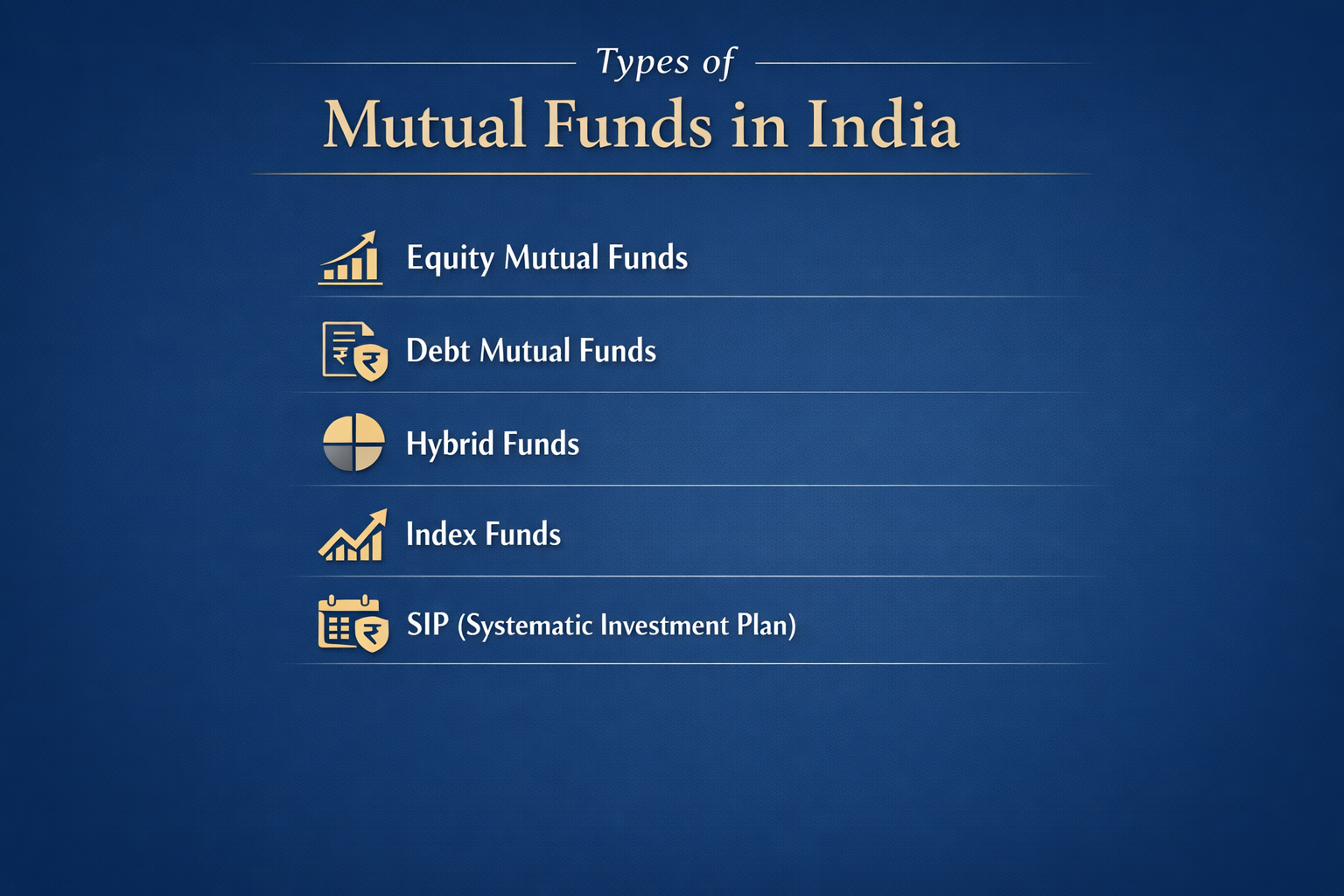
1. Equity Mutual Funds
Invest mainly in stocks. Suitable for long-term investment.
2. Debt Mutual Funds
Invest in bonds and fixed-income securities. Lower risk compared to equity funds.
3. Hybrid Funds
A combination of equity and debt. Balanced risk.
4. Index Funds
Track market indices like Nifty 50 or Sensex.
5. SIP (Systematic Investment Plan)
Allows you to invest a fixed amount monthly. You can start with as low as ₹500.
For beginners searching for how to invest in mutual funds for beginners, SIP is usually the easiest method.
Key Differences Between Stock Market and Mutual Funds
Let’s clearly understand the difference between the stock market and mutual funds.
1. Risk and Volatility
The stock market can be highly volatile. Prices can rise or fall sharply in a short period. Mutual funds reduce risk through diversification. Even if one stock performs badly, others may perform well. If you are looking for safer investment options in India, mutual funds are generally less risky for beginners.
2. Control Over Investment
In the stock market:
- You choose which shares to buy.
- You decide when to buy and sell.
In mutual funds:
- A professional fund manager makes decisions.
- You don’t need to track daily market movements.
If you enjoy research and financial analysis, direct stocks may suit you. If you prefer convenience, mutual funds are better.
3. Knowledge Required
To invest in the stock market successfully, you need to:
- Understand company financial statements
- Analyze market trends
- Study industry performance
- Learn technical and fundamental analysis
Mutual funds require less technical knowledge because experts manage them.
4. Return Potential
Stocks can generate very high returns if you select the right companies at the right time.
However, losses can also be large.
Mutual funds generally offer steady long-term growth. They may not give extremely high short-term profits, but they are suitable for wealth creation strategies.
5. Time Commitment
Stock investing requires:
- Regular monitoring
- Tracking news
- Reviewing quarterly results
Mutual funds require minimal monitoring, especially if you invest through SIP.
For busy professionals, students, or beginners, mutual funds are more convenient.
Which Is Better for Beginners in India?
- Risk Tolerance
If you are comfortable with market ups and downs, you may try stocks.
If you prefer lower stress and stable growth, mutual funds are better.
- Investment Goals
For:
- Retirement planning in India
- Child education planning
- Long-term investment options in India
- Financial planning for beginners
Mutual funds are often a good starting point.
- Experience Level
If you are completely new, start with mutual funds. As you gain knowledge, you can gradually invest in stocks.
Smart Strategy for Beginners
Many financial experts recommend:
- Start with SIP in mutual funds.
- Learn about stock market basics.
- Gradually invest small amounts in quality stocks.
This balanced investment strategy allows you to manage risk while gaining experience.
Common Mistakes to Avoid while investing is stock market or a mutual fund
Whether investing in stocks or mutual funds, beginners should avoid:

- Investing without clear goals
- Expecting quick profits
- Putting all the money into one stock
- Ignoring risk tolerance
- Panic selling during market crashes
Investment planning for beginners should focus on long-term discipline.
Conclusion
If you are just starting your journey:
- Mutual funds are generally better for beginners because they offer diversification and professional management.
- The stock market can offer higher returns but requires knowledge and emotional control.
There is no single perfect option. The best investment option for beginners depends on your goals, time, and risk capacity.
The most important step is to start early and stay consistent.
Frequently Asked Questions (FAQ)
1. Is stock market better than mutual funds for beginners?
For beginners, mutual funds are usually safer and easier to manage. Stocks may provide higher returns but involve higher risk.
2. How to start investing in the stock market in India?
You need:
- Demat account
- Trading account
- KYC verification
- Basic research knowledge
Start small and increase gradually.
3. How to invest in mutual funds for beginners?
You can:
- Complete KYC online
- Choose fund type (equity, debt, hybrid)
- Start SIP with a small amount
- Monitor performance periodically
4. Which is safer, stocks or mutual funds?
Mutual funds are generally safer due to diversification. Stocks are more volatile.
5. Can I invest in both the stock market and mutual funds?
Yes. A combination strategy helps balance risk and return.
6. What is the minimum amount required to start investing?
You can start SIP in mutual funds with ₹500 per month.
For stocks, the minimum amount depends on the share price.
Latest Course





Latest posts





Copyright © By Empirical F&M Academy. Design & Developed by Techno Duniya