
Stock Market Investing in India: Beginners Guide 2026

Stock Market Investing in India: Beginners Guide 2026
Investing in the stock market in India has evolved from being a ‘niche’ investment to a ‘mainstream’ investment tool for wealth creation. As we enter the year 2026, the Indian economy is ready to grow in a big way, and this is the best time for new entrants to begin their financial journey. With Indian investors displaying maturity in their investment behavior and stock prices settling down after recent market corrections, the time is ripe for those who are eager to learn and remain disciplined.
Perhaps the world of finance intimidates you. There’s no need to worry. This tutorial will hold your hand and introduce you to the basics of the subject, so you understand the ‘what, why, and how’ of the share market before you invest your hard-earned cash.
What is the Stock Market?
The stock market, in essence, is where buyers and sellers meet to trade shares of listed companies. When you purchase a share, you are essentially purchasing a part of that company. In India, this is controlled by the Securities and Exchange Board of India (SEBI).
The main platforms for this purpose are the two large stock exchanges:

BSE (Bombay Stock Exchange): Asia's oldest stock exchange, which follows the Sensex index.
NSE (National Stock Exchange): India's largest stock exchange by volume, which follows the Nifty 50 index. Knowledge about stock exchanges is the first step towards successful investment in the share market.
Why Invest in 2026?
The year 2026 marks a special "Goldilocks moment" for Indian investors, which is marked by high growth opportunities and a stabilizing inflation environment. Here's why investing now could be a good idea:
Earnings-Driven Growth: Unlike the past years, where the share prices increased solely obased onhype (multiple expansion), 2026 is expected to be an earnings-driven year.
Home-Grown Growth: Indian households are transforming from "savers" to "investors." Systematic Investment Plans (SIPs) have become a habit, which provides a steady stream of funds into the markets, irrespective of global events
Valuation Comfort: After a phase of high valuations, share prices, especially in the mid and small-cap markets, have corrected, providing better entry points for new investors
Stock Market vs. Share Market Trading
It is important to understand the difference between investing and trading. Although both terms are often used interchangeably, they are used for different purposes:
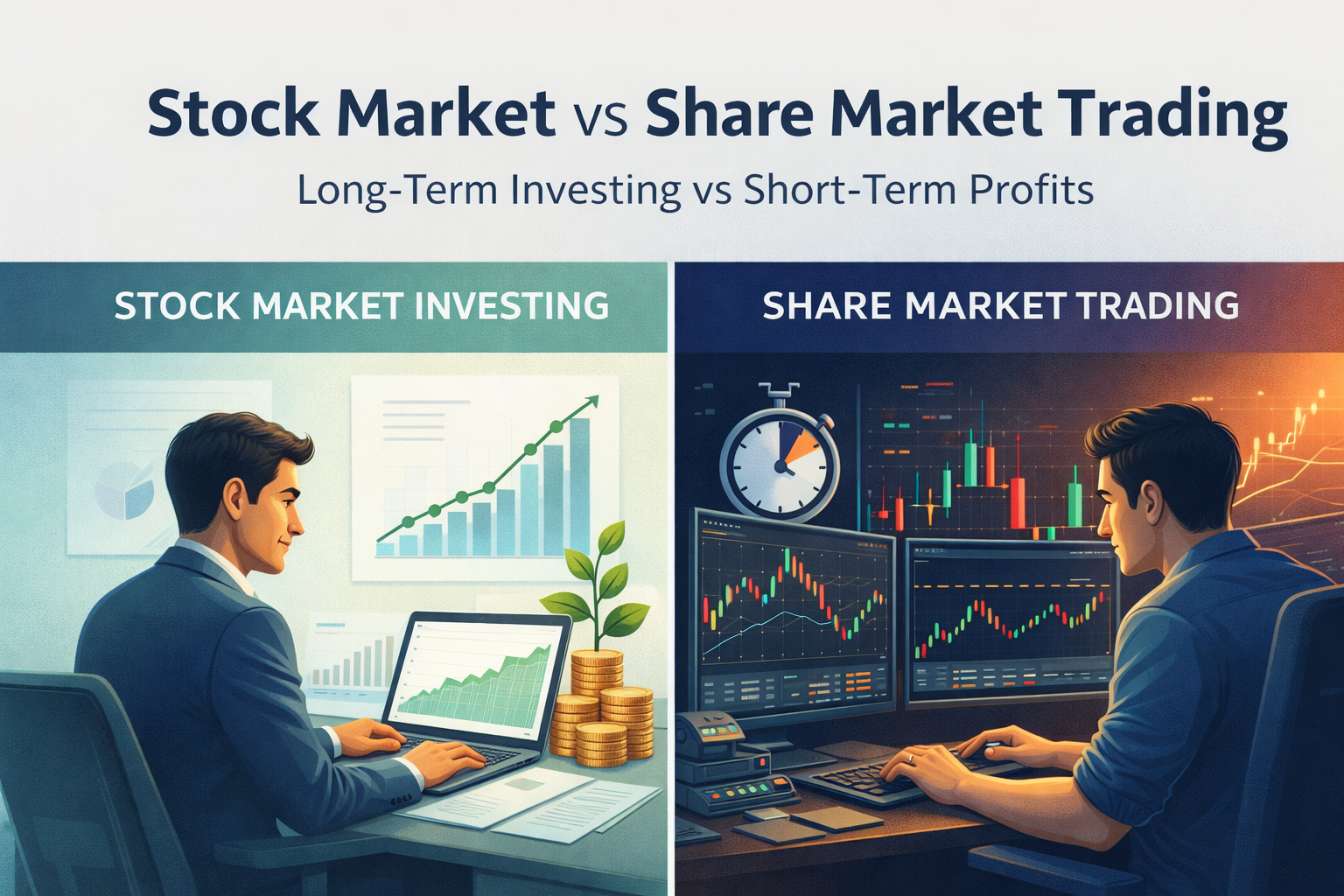
Stock Market Investing: This is a long-term investment strategy. You invest in the stocks of quality companies to hold them for several years, thereby reaping the benefits of the company's growth. This is the best strategy for most beginners.
Share Market Trading: This is the process of buying and selling stocks of companies in a short period of time, such as days, weeks, or months, to make profits from the market's volatility. Share market trading requires extensive knowledge of technical analysis.
For a beginner, it is always better to choose the long-term stock market investment strategy over the share market trading strategy.
How Are Share Prices Determined?
One of the most frequently asked questions by new investors is what determines the movement of share prices. The answer to this question is quite simple: the law of supply and demand.
- More buyers than sellers: The price rises.
- More sellers than buyers: The price falls.
But several factors affect demand and supply:
Company Performance: Earnings and growth have a direct effect on the market.
Economic Conditions: Interest rates, inflation, and GDP growth affect the entire industry.
News and Events: Government announcements, international trends, or company-specific news (such as a new contract) lead to price fluctuations.
Investor Sentiment: Fear and greed are the main causes of short-term price movements, but long-term prices are based on company fundamentals.
A Step-by-Step Guide: Stock Market How to Invest

If you are searching for sow to invest your money in the stock market, you can follow this simple step-by-step guide to begin your investment in the share market.
Step 1: Define Your Goals and Risk Profile
You have to ask yourself what your objectives for investment are. Are you planning to invest in your retirement, a house, or your child's education? Your objectives will assist you in understanding your time horizon and risk tolerance.e
Step 2: Open a Demat and Trading Account
To invest in the share market, you have to open a Demat account (for storing shares in an electronic form) and a trading account (for buying/selling shares). You can open these accounts with registered stockbrokers such as Zerodha, Groww, Upstox, or banks.
Step 3: Select Stocks for Your Portfolio
As a beginner in 2026, you have to select stocks of large and established companies with a history of stability. These stocks are known as "blue-chip" stocks. Based on the current market analysis, here are a few examples of companies that are generally considered to be the building blocks of a beginner's portfolio due to their sound governance and market presence. With business interests in retail, telecom, and energy, Reliance Industries is a diversified major.
HDFC Bank is a well-known name in the banking industry for its excellent management and profitable track record.
Tata Consultancy Services (TCS), a world leader in the IT industry, has a robust balance sheet and is known to be shareholder-friendly.
Hindustan Unilever (HUL) is a reliable and custodial FMCG business with strong brands.
Step 4: Begin with a Small Amount
You do not require a large amount of money to begin investing. You can begin with a small amount of money using the compounding technique. It is always advised that you begin with a stock or mutual fund "SIP".
Step 5: Make Your Portfolio More Diverse
Don't put all of your money into a single industry or stock. Invest in a variety of industries to diversify your portfolio, including banking, IT, FMCG, and automobiles. In the event that one sector underperforms, this will protect your portfolio.
Important Industries to Keep an Eye on in 2026
Knowing which economic sectors are doing well is crucial for making wise decisions. In 2026, analysts are currently keeping an eye on the following sectors:
Banking & Financials: This industry seems positive as bad loans are under control, and credit growth is anticipated to improve.
Discretionary Consumption: It is anticipated that industries like travel, consumer durables, and automobiles will gain from increased purchasing power, which may be supported by pay commission payments.
AI & Infrastructure: Instead of focusing on IT services, one could explore firms that help in the development of AI, like data center firms, cooling solutions, and power firms.
Common Mistakes Beginners Should Avoid
The share market for beginners can be very confusing. Here are some mistakes to avoid:
Emotional Decisions: Panic-selling when the market goes down, or greed-driven buying when the market goes up, can result in the loss of all your money. Remain calm and stick to your strategy.
Ignoring Diversification: Putting all your money into one "trending" stock is a surefire way to lose all your money.
Expecting Quick Money: The share market is a long-term investment, not a get-rich-quick scheme. Patience is the key to unlocking the power of compounding.
Conclusion
The Indian share market in 2026 presents a bright future for those who are ready to take a disciplined and informed route. By learning the basics, beginning with quality companies, and keeping your sights on the long-term goal, you can tackle the world of stock market investment with confidence. Don’t forget, every expert was once a beginner. Begin today, be patient, and watch your money grow along with the growth story of India.
Latest Course





Latest posts





Copyright © By Empirical F&M Academy. Design & Developed by Techno Duniya