
7 Common Intraday Trading Mistakes & How to Avoid Beginner's Guide

7 Common Intraday Trading Mistakes & How to Avoid Beginner's Guide
Intraday trading looks deceptively simple from the outside. Buy low, sell high, and repeat the entire process. But anyone who's actually sat in front of trading charts with real money on the line knows it's a completely different thing. The trading market moves fast, punishes hesitation, and has a way of making even experienced traders second-guess themselves.
At Empirical, we've seen what separates traders who build consistent results from those who burn through capital chasing momentum. More often than not, it isn't a lack of knowledge; it's a handful of avoidable mistakes made on repeat. So let's break down the seven most common ones, and more importantly, how you can stop making them.
1. Skipping a Defined Trading Strategy
This is where most beginners, and plenty of intermediate traders, go wrong. They enter the trading market with a vague idea that the stock looks good today, rather than having a concrete plan. Without a defined trading strategy, every trade becomes an improvised guess.
Before you place a single order, you need answers to:
- What's my entry condition? - Based on price action trading signals, a breakout level, or a moving average crossover?
- Where's my stop-loss? - Non-negotiable. Define it before you enter.
- What's my profit target? - Know when you're getting out on the upside, too.
- How much am I risking per trade? - Ideally, no more than 1–2% of your capital.
A strategy doesn't need to be complex. It needs to be consistent. Build it, test it, and follow it even when your gut is screaming otherwise.
2. Ignoring Stock Trading Timing
Ask any seasoned intraday trader about stock trading timing, and they'll tell you that when you trade matters just as much as what you trade. The Indian markets (NSE/BSE) have distinct phases during the trading session, and each behaves differently.
Here's a general pattern most experienced traders follow:
- 9:15 AM to 9:30 AM: High volatility, wide spreads. Risky for new traders, but momentum players watch closely.
- 9:30 AM to 11:30 AM: Often the most liquid and trending window. Best for intraday setups.
- 11:30 AM to 1:30 PM: Markets can drift or consolidate. Lower participation.
- 1:30 PM to 3:15 PM: Volume picks up again, especially as institutional activity resumes.
- 3:15 PM to 3:30 PM: Expiry and closing volatility. Proceed with caution.
Jumping into trades during dead hours and sitting out the best windows is a mistake that costs more than people realise.
3. Overtrading - More Trades Do Not Always Bring More Profits
One of the most seductive traps in intraday trading is the urge to always be in a trade. The market is moving, the screen is flashing, and sitting out feels like leaving money on the table.
It isn't.
Overtrading leads to:
- Higher brokerage and transaction costs are eating into margins
- Emotional fatigue that degrades decision-making
- Chasing setups that don't actually meet your criteria
- Compounding losses when one bad trade leads to revenge trading
The best intraday trading tip here is simple: wait for your setup. Quality beats quantity every single session.
4. Misreading or Ignoring Trading Charts
Stock market trading without reading charts properly is like driving without looking at the road. Trading charts aren't just pretty patterns — they're a visual record of market psychology, supply and demand, and momentum.
Common charting mistakes include:
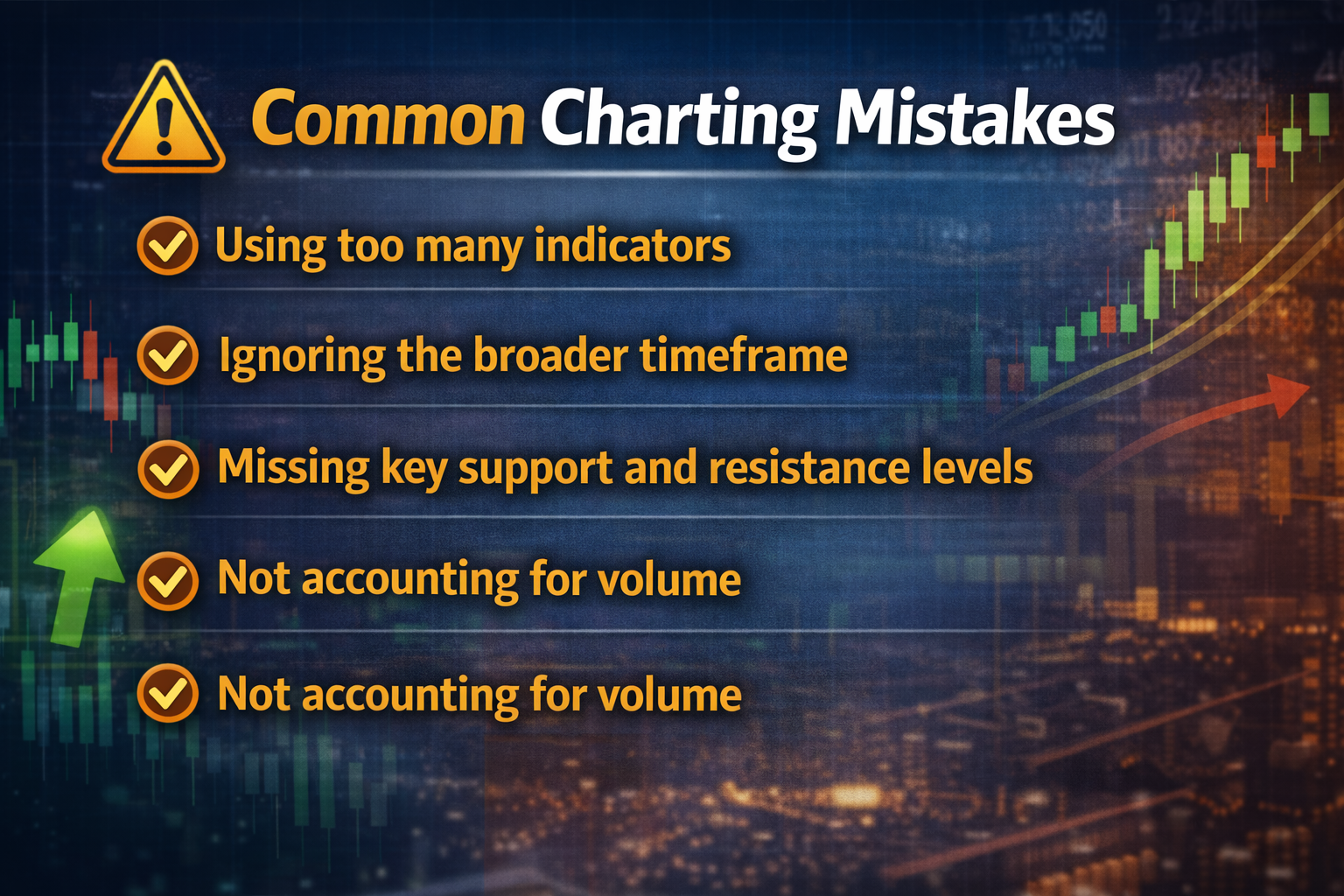
- Using too many indicators - Three conflicting signals cancel each other out. Pick what works and stick with it.
- Ignoring the broader timeframe - A sell signal on a 5-minute chart means little if the hourly chart is in a strong uptrend.
- Missing key support and resistance levels - These are the zones where price action trading setups actually form.
- Not accounting for volume - Price moves without volume are suspect. Volume confirms conviction.
Spend time learning to read charts cleanly. A bare chart with price action trading principles will often outperform a cluttered one loaded with indicators.
5. Letting Losses Run and Cutting Winners Short
This is the psychological reversal that kills trading accounts. It goes against human instinct; we hold losing trades hoping they'll recover, and we exit winning trades early out of fear of giving profits back.
The result? A portfolio full of small wins and large, ugly losses.
Discipline yourself to do the opposite:
- Respect your stop-loss. If it's hit, the trade is done.
- Let your winners breathe. Use trailing stops or pre-set targets to capture more of a move without micromanaging every tick.
- Track your win/loss ratio and your average win vs. average loss. A 40% win rate can still be profitable if your average winner is twice your average loser.
This is where stock trading becomes a mental game as much as a technical one.
6. Poor Stock Buying Decisions
It's a familiar scenario. You spot a stock on your watchlist, hesitate for a moment, and then watch it shoot up. In a moment of fear, you buy at the top, right before it stalls and reverses.
Chasing price is one of the most expensive habits in stock buying. Here's how to break it:
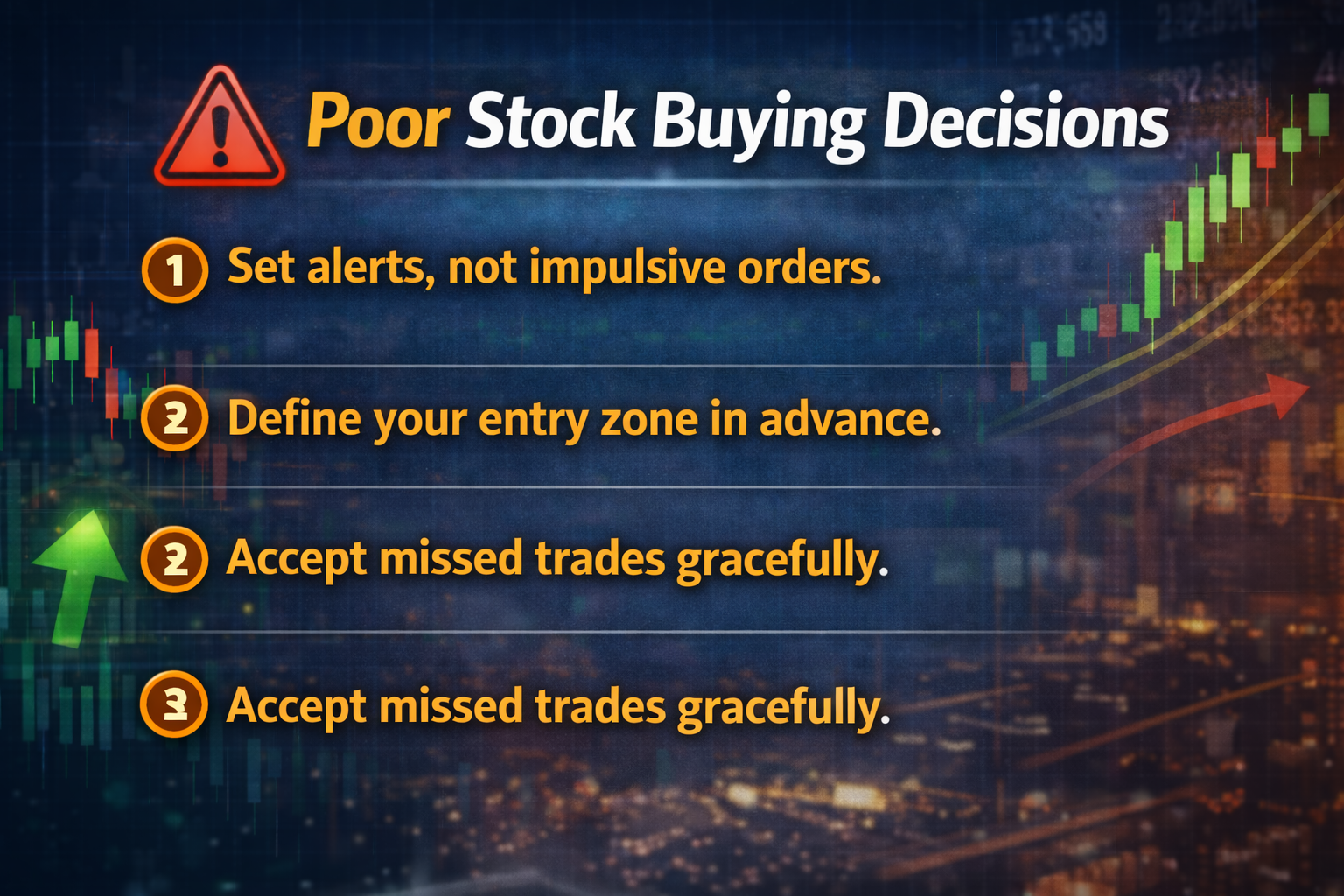
- Set alerts, not impulsive orders. Let the stock come to your level rather than you chasing its current level.
- Define your entry zone in advance. Know the price range where your setup is valid, and if the stock is beyond that zone, the trade is off.
- Accept missed trades gracefully. The market opens again tomorrow. A missed opportunity beats a forced loss.
Good stock buying in the intraday space is about patience and precision, not speed.
7. Neglecting a Trade Journal
This one is underrated and almost universally ignored by traders who aren't progressing. A trade journal isn't just a record, but it's your feedback loop.
Log every trade with:
- Entry and exit price
- The setup or reason for the trade
- Your emotional state at the time
- What went right or wrong
- Screenshots of the chart at entry
After a few weeks, patterns emerge. You'll notice you consistently lose on trades taken after noon. Or that your best setups come from one particular price action trading pattern. Or that you overtrade on days when you're stressed.
No intraday trading tips article or course will ever give you insights as precise and personal as your own trading data. Build the habit.
Final Thoughts
Intraday trading is a skill, not a lottery. Every mistake listed above is fixable, but only if you're aware of it and willing to do the unsexy work of correcting it. Define your strategy, respect timing, read your charts, manage your emotions, and document everything.
At Empirical, we believe that better decisions come from better data and better habits. The traders who last aren't the ones who never lose, they're the ones who learn faster than everyone else.
Latest Course





Latest posts




Copyright © By Empirical F&M Academy. Design & Developed by Techno Duniya