
Trade Republic: Stock Market Investing Guide
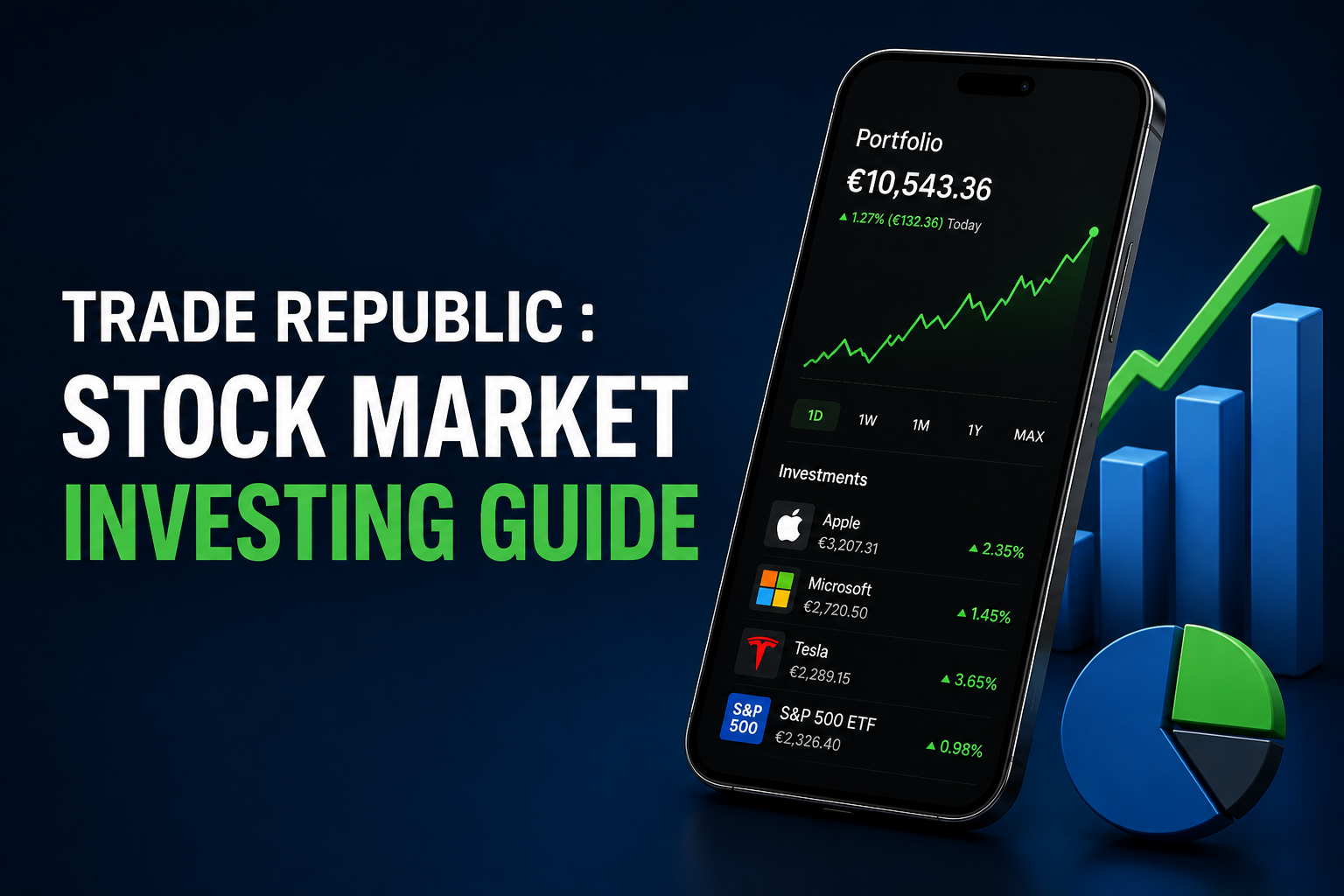
Trade Republic : Stock Market Investing Guide
You may have come across the name "Trade Republic" somewhere in a finance news feed, a European trading app suddenly worth over €12 billion, cutting nearly every fee that traditional brokers charge, and turning stock market investing into something as simple as a few taps on a phone. Naturally, the question that follows is: what exactly is this platform, and does any of it matter if you're investing from India?
In this guide, we'll break down what Trade Republic actually is, how its stock market model works, why it keeps showing up in financial headlines in 2026, and, more importantly, what lessons Indian retail investors and traders can pull from its rise, regardless of whether you ever use the platform yourself.
What Is Trade Republic?
Trade Republic is a Berlin-based trading and banking app that lets European retail investors buy stocks, ETFs, bonds, and a limited range of crypto assets, all through a mobile-first platform. It was built around one simple idea: strip out the complexity and cost that usually comes with investing, and make it accessible to someone starting with as little as 1.
Key features of the platform:
- Fractional investing: you can buy a small slice of an expensive stock or ETF instead of a full unit
- Flat, low-cost trade settlement: a small fixed fee per trade instead of a percentage-based brokerage
- Automated savings plans: recurring monthly investments into stocks, ETFs, or crypto, often with zero execution cost
- A full banking layer: a current account, debit card, and interest on idle cash, since the company now operates under its own banking licence
- Mobile-only experience: almost the entire platform lives inside the app, with very limited desktop functionality
If this sounds familiar, that's because the model echoes what discount brokers have already done in India over the last several years stripping brokerage costs down, going mobile-first, and making the account-opening process almost entirely digital. The difference is that Trade Republic combined this with an actual banking licence, which is a step most Indian discount brokers haven't taken.
Why Is Trade Republic in the News in 2026?
A few developments have kept this platform in financial headlines through the year, and they're worth understanding even if you never plan to use the app.
1. A valuation jump that surprised the market
A secondary share sale valued the company at roughly €12.5 billion, more than double its valuation from just a couple of years earlier. Notably, this transaction didn't inject fresh capital into the company it simply let early investors and employees sell shares to new backers at a much higher price, which is usually read as a strong vote of confidence from the market rather than a sign the company needs more funding.
2. Turning consistently profitable
Unlike many trading apps that grew fast but stayed unprofitable for years, this platform has now posted profits for multiple years in a row, largely on the back of transaction volume, interest income on customer cash, and revenue from routing trade orders to market makers.
3. A regulatory shift that's forcing a business model change
A large part of how the platform kept its fees so low was through a practice called Payment for Order Flow (PFOF) essentially getting paid by market makers for directing customer trades to them. Regulators in the European Union have been phasing this practice out, with a full ban taking effect in mid-2026. This is forcing the company to rebuild parts of its revenue model around subscriptions, interest income, and other services instead of relying on order-flow payments.
4. IPO speculation
No public listing has been confirmed, but the scale of the valuation, the shift to consistent profitability, and the broader wave of fintech companies eyeing public markets have all fuelled speculation about whether this could eventually go public.
Is Trade Republic Available in India?
No. This is one of the most searched questions around the platform, and the direct answer is that it currently operates only across European markets and is regulated by European financial authorities. It is not licensed to onboard Indian residents, and Indian investors cannot open an account on it the way they would with a domestic discount broker.
That said, understanding how it operates is still genuinely useful for Indian market participants, for a reason that has nothing to do with actually using the app:
- It's a live, large-scale case study of what happens when a "zero-commission" or "flat-fee" model scales to millions of users
- The regulatory pushback it's now facing over order-flow payments is a preview of the kind of scrutiny low-cost trading models eventually attract everywhere
- Its shift toward a banking-plus-investing model mirrors a trend several Indian platforms have also been leaning into
What Indian Investors and Traders Can Learn From This
Here's where the actual value lies for someone learning to navigate the Indian stock market — not in the app itself, but in the patterns behind its growth.
1. "Low-cost" and "free" are never actually free
One of the most important lessons from this platform's story is how a firm can offer near-zero visible fees while still being profitable and, eventually, worth billions. The cost doesn't disappear; it just moves somewhere less visible — in this case, through payments received for routing trade orders, interest earned on customer cash sitting idle in accounts, and, in some structures, wider bid-ask spreads baked into execution prices. Indian investors comparing "zero brokerage" claims across domestic platforms should apply the same scrutiny: read the fine print on account maintenance charges, payout timelines, and how order execution actually works, not just the headline fee.
2. Fractional investing lowers the entry barrier, but doesn't remove the need to learn
Being able to invest with a tiny amount of money is genuinely powerful for building a habit early, something we've covered in detail in our piece on how to start investing with a small amount like ₹5,000. But a low entry barrier only helps if it's paired with an understanding of what you're actually buying. A €1 minimum investment doesn't make a stock or ETF a good investment on its own merit.
3. Automated savings plans work because they remove emotion from the process
The recurring, automated investment plans this platform is built around function on the same principle as a Systematic Investment Plan in India — invest a fixed amount at fixed intervals, regardless of what the market is doing that day. This approach consistently outperforms emotional, one-off decision-making for most retail investors, largely because it removes the temptation to time entries and exits based on short-term noise.
4. Regulatory scrutiny eventually catches up with every "too good to be true" fee structure
The pending ban on payment-for-order-flow in Europe is a useful reminder that regulators everywhere eventually step in once a business model scales large enough to raise conflict-of-interest concerns. Indian traders who follow how FIIs and DIIs move Indian markets already understand how much regulatory and institutional behaviour shapes outcomes — this is simply the European equivalent playing out in the retail brokerage space.
5. Mobile-first investing is now the global default, not a niche trend
The near-total shift to app-based investing, with limited or no desktop platform, reflects where retail participation is heading globally. For Indian beginners still building comfort with reading charts, indicators, and market signals on a phone screen, our guide on reading day trading indicators and market signals is a good next step once the basics of an app-based platform feel familiar.
How This Compares to the Indian Discount Broking Model
It's worth laying this out plainly, since the comparison is where most of the practical learning sits.
- Fee structure: Both models rely on low, flat, or near-zero visible charges rather than percentage-based brokerage
- Revenue source: Indian discount brokers typically earn through futures and options volumes, account charges, and interest on client funds; the European model leaned heavily on order-flow payments, now being phased out
- Regulatory environment: India's brokerage and market infrastructure rules differ significantly from the EU's, so a regulatory shift in Europe doesn't automatically translate to Indian platforms, though the underlying pressure, transparency in execution and fee disclosure — is a global theme
- Banking integration: the European platform combined investing with full banking services; a few Indian platforms have started moving in this direction, but full banking licences remain rare among broking apps in India
- User base and market maturity: Europe's retail investing culture is still catching up to markets like the US in participation rates, similar to how Indian retail participation has grown sharply but still trails more mature markets
Common Misconceptions Worth Clearing Up
- "A billion-dollar valuation means the platform is the safest option available" — valuation reflects investor confidence in growth and profitability, not a guarantee of safety or suitability for every investor
- "Zero commission trading has no cost anywhere in the chain" — there's almost always a cost somewhere, whether visible or embedded in execution
- "This platform will eventually expand to India" — there's no confirmed plan for this, and regulatory licensing alone would be a long, uncertain process even if the company chose to pursue it
- "A flat-fee, mobile-first model is inherently better than a full-service broker." it depends entirely on what kind of investor or trader you are; active traders needing advanced charting, multiple asset classes, or desktop tools often find such platforms limiting
The Bigger Picture for Beginners
Whether the platform in question operates in Berlin, Mumbai, or anywhere else, the underlying principles of building wealth in the stock market don't change: understand what you're investing in, know exactly how a platform makes its money, and build consistent habits rather than chasing the lowest fee on paper. Watching how global trading platforms evolve, including the regulatory pressure they eventually face, is a useful way to sharpen your own judgment as an investor, even when the platform itself is out of reach.
If you're building your own understanding of how global market shifts ripple into Indian portfolios, our breakdown of how global markets are affecting Indian stocks in 2026 is a good companion read to this one, and there's plenty more on our blog if you want to keep building your market knowledge from the ground up.
Frequently Asked Questions (FAQ)
1. What is Trade Republic? It's a Berlin-based, mobile-first trading and banking app that lets European investors buy stocks, ETFs, bonds, and select crypto assets with very low, flat fees.
2. Can Indian investors use Trade Republic? No. It currently operates only in European markets under European regulatory licensing and doesn't onboard Indian residents.
3. Why is Trade Republic valued at over €12 billion? A secondary share sale in late 2025 valued the company at approximately €12.5 billion, reflecting strong investor confidence following several consecutive years of profitability.
4. How does Trade Republic make money if its fees are so low? Primarily through payment for order flow, interest earned on customer cash balances, and a small flat settlement fee per trade — though the order-flow revenue stream is being phased out under new EU rules.
5. Is Trade Republic going public? No IPO has been officially confirmed as of 2026, though its scale and profitability have fuelled ongoing speculation about a future public listing.
Final Thoughts
Trade Republic's rise is less about one company and more about a global shift in how retail investors expect to access the stock market: cheaply, quickly, and almost entirely through a phone. Indian investors don't need access to this specific platform to benefit from the lessons it offers: understanding fee structures, questioning how "free" trading is actually funded, and building consistent, automated investing habits are principles that apply just as well to any market you're actually trading in.
Latest Course



Latest posts




Copyright © By Empirical F&M Academy. Design & Developed by Techno Duniya