
Why S&P Says U.S. Tariffs Won’t Derail India’s Long-Term Growth
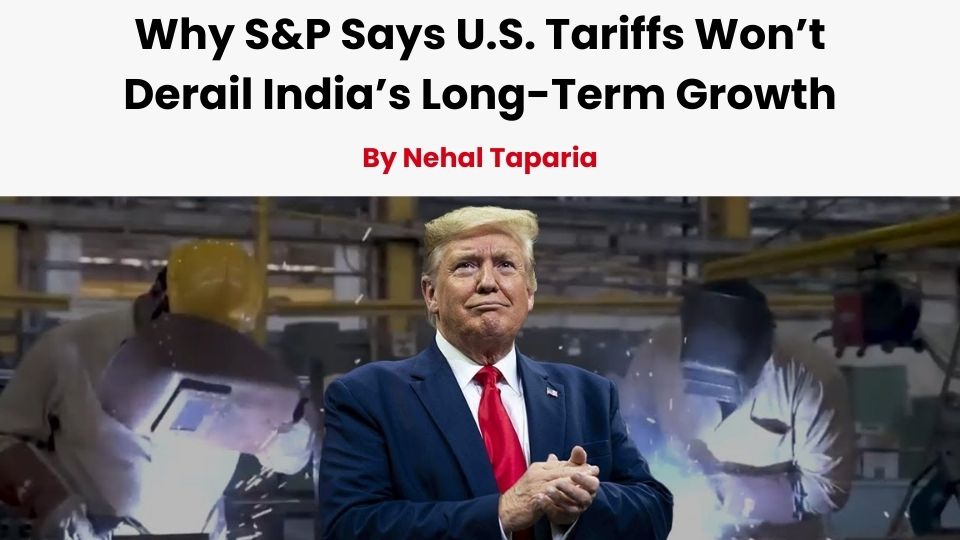
Why S&P Says U.S. Tariffs Won’t Derail India’s Long-Term Growth
1. S&P’s Key Takeaways
- U.S. tariffs unlikely to dent long-term growth
S&P Global Ratings highlighted that India’s long-term growth trajectory remains solid despite high tariffs, citing strong domestic foundations and economic reforms. - Credit rating upgrade reflects confidence
India’s sovereign rating was raised from ‘BBB-’ to ‘BBB’ with a stable outlook—a first since 2007—reflecting robust growth, fiscal discipline, and effective monetary policy. - Domestic economy acts as a buffer
Only about 1–2% of India’s GDP comes from exports to the U.S., making the economy less vulnerable to U.S. trade shocks. Domestic consumption (~85–99% of GDP) forms the core growth driver. - Structural strengths matter more
Infrastructure improvements, business-friendly policies, and continued reforms are key to sustaining and even enhancing India’s growth path ().
2. Broader Perspectives
- Short-term growth impacts:
Experts warn that manufacturing and labor-intensive sectors could feel pressure, and GDP might be marginally affected—estimates range from a 0.1% to 0.4% slowdown in FY26. - Moody’s and Morgan Stanley estimates:
Moody’s warns of a potential 0.3 percentage point drag on GDP, while Morgan Stanley suggests an 80 basis point (0.8%) cut unless countered by government action. - Strong domestic demand cushions the blow:
Analysts note that India’s resilient internal demand will likely soften external shocks. - Opportunity in adversity:
Amitabh Kant sees this as India’s “Agneepath moment”—a strategic crisis that could catalyze bold reforms and long-term transformations.
What It Means for Indian Markets
|
Factor |
Market Implication |
|
Credit Rating Upgrade |
Positive sentiment, lower borrowing costs, improved investor confidence. |
|
Sectoral Pressure |
Export-oriented, manufacturing firms may face margin pressure or delays. |
|
Policy Reforms |
Government measures (e.g., diversification, infrastructure, reforms) could bolster long-term growth (). |
|
Domestic Demand Resilience |
Consumption-driven sectors remain strong; domestic plays stay attractive. |
|
Strategic Realignment |
Push towards China-plus strategies, services growth, foreign investment inflows. |
Bottom Line
S&P’s outlook remains firmly optimistic: India’s fundamentals are strong enough to withstand short-term trade shocks. The credit upgrade, robust domestic consumption, and reform momentum all signal continued growth—though challenges in export sectors should be watched closely.
By Nehal Taparia
This content is for educational and knowledge purposes only and should not be considered as investment or Trading advice. Please consult a certified financial advisor before making any investment or Trading decisions.
Latest Course





Latest posts




Our Recent FAQS
Frequently Asked Question &
Answers Here
Q1: Why is S&P confident despite tariffs?
S&P cites India’s limited export exposure to the U.S.—just 1–2% of GDP—and robust domestic demand (~85–99% of GDP). Exemptions in pharma and electronics further shield the economy.
Q2: Could U.S. tariffs hurt India's GDP growth?
Q3: How will markets react?
Q4: What reforms can mitigate tariff impacts?
Q5: Can this be turned into an advantage?
Copyright © By Empirical F&M Academy. Design & Developed by Techno Duniya