Best Intraday Trading Course Online: What You Actually Learn (2026 Guide)
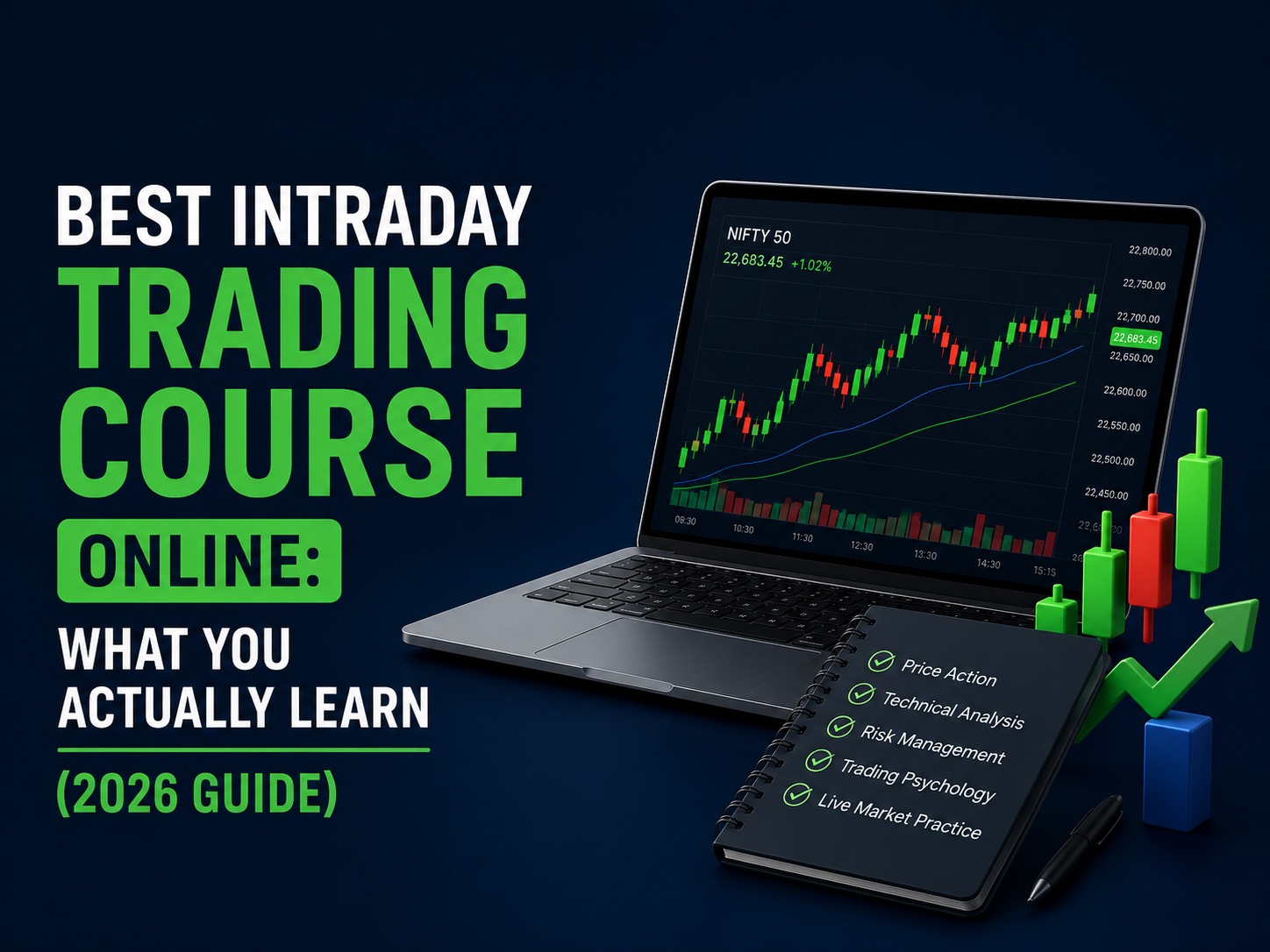
Best Intraday Trading Course Online: What You Actually Learn (2026 Guide)
Search "intraday trading course online," and you'll get hundreds of options promising to turn you into a profitable day trader in a few weeks. Most of them won't tell you what's actually inside the syllabus, how the course is structured, or what kind of trader it's actually built for. This guide does the opposite; it breaks down what a genuinely useful intraday trading course should cover and walks through exactly what's inside our own Intraday Trading Certification Program, so you know precisely what you're signing up for before you do.
Why Intraday Trading Needs Formal Training in the First Place
Intraday trading, or day trading, means buying and selling financial instruments- stocks, indices, commodities, or currencies within the same trading session, closing every position before the market shuts for the day. The appeal is obvious: no overnight risk, and the potential to profit from short-term price movement without tying up capital for weeks or months.
The problem is that intraday trading rewards precision and punishes guesswork almost immediately. Unlike long-term investing, where a bad entry can be corrected by simply waiting it out, an intraday position that goes wrong has to be dealt with the same day, often within minutes. That combination of fast decisions, real capital, and very little room for error is exactly why most beginners who jump into day trading without structured learning burn through capital quickly. A proper course exists to compress the learning curve that would otherwise take years of trial and error (and real losses) to work through on your own.
What a Genuinely Useful Intraday Trading Course Should Teach?
Before looking at any specific program, it helps to know what separates a course that actually builds trading skill from one that's just a collection of generic tips. At minimum, a serious intraday course should cover:
- Core trading concepts and strategy frameworks - not just individual tips, but a structured way of thinking about setups
- Indicators built for speed - tools designed for short time frames, not long-term charting indicators repurposed for intraday use
- Momentum and volatility reading - understanding when a stock is actually moving with conviction versus just noisy price action
- Market scanning tools - a systematic way to find tradeable setups instead of scrolling through charts randomly every morning
- Risk management as a core module, not an afterthought - position sizing, stop-loss discipline, and capital protection rules
- Trading psychology - because most intraday losses come from emotional decisions, not from a lack of technical knowledge
If a course skips risk management and psychology to focus purely on "strategies," it's teaching half the skill set. The strategies get you into a trade; risk management and psychology are what keep you in the game long enough to become consistently profitable.
Inside the Intraday Trading Certification Program
Our own Intraday Trading Certification Program is built directly around that full skill set, rather than treating strategy as the only thing worth teaching. Here's what it actually includes:
- Duration: 10 hours of structured content
- Skill level: Foundation — built for beginners, with no prior trading experience required
- Format: Online, self-paced, with interactive elements including live sessions, trading simulations, case studies, and discussion-based learning
- Certification: A recognised certificate on completion, validating proficiency in intraday trading
- Access: Lifetime access to course materials and updates, so the learning doesn't stop the day the course ends
The Curriculum, Topic by Topic
- Concept of Trading Strategies: the foundational frameworks that every subsequent module builds on
- Speculative Trading Indicators: tools designed specifically for reading short-term price action rather than long-term trend indicators
- Momentum Trading Indicators: identifying when a stock has real directional conviction behind a move
- Volatility Advantage: understanding how to use volatility rather than being caught off guard by it
- Market Scanners: building a repeatable, systematic process for finding tradeable setups each session
- Speculative Strategies: applying the frameworks learned earlier to real, varying market conditions
- Risk Management: position sizing, stop-loss placement, and capital protection — the module most beginners skip and regret skipping
- Trading Psychology: discipline, emotional control, and the mental habits that separate consistent traders from one-off lucky trades
This is deliberately sequenced — concepts first, then the technical toolkit, then risk and psychology last, since those final two modules only make sense once you understand what you're actually managing risk and discipline around.
Who This Course Is Actually Built For?
- Stock market enthusiasts with basic trading knowledge looking to formalise their understanding
- Students exploring finance and trading as a potential career path
- Working professionals considering a shift into trading, either full-time or as structured side income
- Existing investors or traders who already trade but want a more systematic, less reactive approach
You don't need prior trading experience to start. The program is built to begin with fundamentals and progress toward more advanced intraday-specific strategy, which matters if you're coming in with zero background and don't want to feel lost by session three.
How This Fits Into a Broader Learning Path?
Intraday trading is one specific style within a much larger set of approaches, and it isn't automatically the right starting point for everyone. If you're still deciding between a faster, same-day trading style and a slightly longer holding-period approach, comparing swing trading and intraday trading directly is worth doing before committing time and capital to either.
Reading market signals well is also closely tied to understanding what's actually moving the broader market on any given day — large institutional flows often explain price action that looks confusing at the individual stock level, and how FII and DII activity drives Indian markets is a useful companion concept once you start scanning for setups regularly. And if capital allocation is still an open question before you even get to strategy, starting with a smaller amount like ₹5,000 covers how to think about position sizing from the very first trade onward.
What You Actually Walk Away With?
By the end of the program, the goal isn't just familiarity with a list of indicators it's a repeatable process: how to scan for setups, how to size a position, where to place a stop-loss before entering (not after), and how to recognise when a day's conditions simply aren't worth trading at all. The certification itself adds a credential to your profile, but the more durable outcome is the discipline and process built through the risk management and psychology modules, which is what actually determines whether a trader survives their first year.
Frequently Asked Questions (FAQ)
1. Do I need prior trading experience to join this course?
No. The program starts with foundational concepts and progresses gradually into more advanced intraday-specific strategies.
2. Is the course live or self-paced?
It's structured as an online, self-paced program that also includes interactive elements- live sessions, simulations, and case study discussions.
3. Will I get a certificate after completing the course?
Yes, a recognised certification is issued on successful completion of the Intraday Trading Certification Program.
4. Do I get lifetime access to the course material?
Yes, all participants get lifetime access to course content, updates, and resources.
5. How long is the course?
The program runs for 10 hours of structured content at the Foundation skill level.
Final Thoughts
Intraday trading isn't difficult to understand conceptually: buy and sell within the same session, avoid overnight risk, but it's genuinely difficult to execute well without structure. The traders who last aren't the ones who found one clever indicator; they're the ones who built a repeatable process around strategy, risk, and discipline together. If that's the kind of foundation you're looking to build, the Intraday Trading Certification Program walks through all of it, from the first concept to the risk and psychology work that actually keeps a trading account alive.
Latest Course
Latest posts


Copyright © By Empirical F&M Academy. Design & Developed by Techno Duniya