
How to Start Intraday Trading in 2026: A Beginner’s Step-by-Step Guide

How to Start Intraday Trading in 2026: A Beginner’s Step-by-Step Guide
Intraday trading has become one of the fastest-growing ways to participate in the stock market in 2026. With mobile trading apps, AI-powered charting tools, and easy market access, more beginners are exploring day trading to generate short-term profits.
But here’s the reality: intraday trading is not about luck or random stock tips. Successful traders focus on discipline, risk management, and proper market understanding.
If you are planning to start your trading journey, this beginner-friendly guide will help you understand how intraday trading works, how to start safely, and what strategies beginners should follow in 2026.
What is Intraday Trading?
Intraday trading, also known as day trading, means buying and selling stocks within the same trading day. Traders aim to profit from small price movements in stocks, indices, or derivatives.
For example, if you buy a stock at ₹500 in the morning and sell it at ₹515 before the market closes, the ₹15 difference becomes your profit.
Unlike long-term investing, intraday trading focuses on short-term opportunities and requires quick decision-making.
If you are completely new to trading, reading about Does Technical Analysis Work in Intraday Trading? can help you understand how technical analysis supports day trading decisions.
Why Intraday Trading is Popular in 2026?
Intraday trading has become more accessible than ever because of:
- Low brokerage trading platforms
- AI-based stock scanners
- Faster execution tools
- Real-time chart analysis
- Availability of online trading courses
- Increased awareness about financial markets
Step 1: Learn the Basics Before Investing Money
One of the biggest mistakes beginners make is directly entering live markets without understanding the basics.
Before starting intraday trading, learn:
- How the stock market works
- What moves stock prices
- Candlestick patterns
- Support and resistance
- Trading psychology
- Risk management basics
Understanding technical indicators is extremely important for day trading. Tools like RSI, VWAP, MACD, and Moving Averages help traders identify market momentum and possible entry points.
You can also explore How to Read Day Trading Indicators & Market Signals Like a Pro to improve chart-reading skills.
Step 2: Choose the Right Trading Platform
Your trading platform plays a major role in intraday trading success.
A good trading platform should provide:
- Fast order execution
- Live charts
- Low brokerage fees
- Technical indicators
- Easy-to-use interface
- Reliable customer support
Popular platforms used by Indian traders include:
- Zerodha
- Groww
- Angel One
- Upstox
As a beginner, avoid using multiple platforms initially. Focus on mastering one platform properly.
Step 3: Open a Demat and Trading Account
To start intraday trading in India, you need:
- PAN Card
- Aadhaar Card
- Bank Account
- Mobile Number linked with Aadhaar
Most brokers now allow fully online account opening within a few hours.
Step 4: Start Small and Focus on Learning
In 2026, smart traders focus more on protecting capital than chasing quick profits.
If you are a beginner:
- Start with ₹5,000–₹10,000
- Trade with small quantities
- Learn market behavior first
- Avoid leverage initially
Many experienced traders recommend beginning with small capital before moving to advanced setups. You can also read How to Start Trading with Just ₹5000 for beginner-friendly insights.
Step 5: Learn Basic Intraday Trading Strategies
Successful intraday trading depends heavily on strategy and discipline.
Momentum Trading- In this strategy, traders buy stocks moving strongly in one direction with high volume.
Breakout Trading- Traders enter when a stock breaks an important resistance or support level.
Scalping- Scalpers take multiple small trades during the day to capture tiny price movements.
Reversal Trading- This strategy focuses on identifying trend reversals after strong upward or downward movement.
Beginners should focus on one strategy first instead of trying everything together.
If you want structured learning, the Intraday Trading Strategies Program covers beginner-to-advanced trading concepts, including momentum, volatility, and trading psychology.
Step 6: Understand Risk Management
Risk management is what separates successful traders from gamblers.
Never enter a trade without:
- Stop loss
- Target price
- Proper position sizing
For example:
- Buy stock at ₹200
- Stop loss at ₹195
- Maximum loss = ₹5 per share
Professional traders focus on limiting losses instead of maximizing profits.
A good rule for beginners:
Never risk more than 1–2% of your capital on a single trade.
Step 7: Learn Technical Analysis
Technical analysis is one of the most important skills in intraday trading.
It helps traders:
- Identify trends
- Find entry and exit points
- Understand momentum
- Avoid emotional decisions
Popular indicators for beginners in 2026 include:
- RSI
- MACD
- VWAP
- Moving Averages
- Bollinger Bands
If you want to improve your technical analysis knowledge, explore Complete Beginner’s Guide to Fundamental vs Technical Analysis.
Step 8: Focus on Liquid Stocks and Indices
Avoid random penny stocks in intraday trading.
Beginners should trade:
- Nifty 50 stocks
- Bank Nifty
- High-volume stocks
- Large-cap companies
Liquid stocks usually provide:
- Better price movement
- Lower slippage
- Easier trade execution
You can also understand index trading better through Mastering the Nifty 50 Index for Day & Intraday Traders.
Common Intraday Trading Mistakes Beginners Make
Most new traders lose money because of emotional decisions.
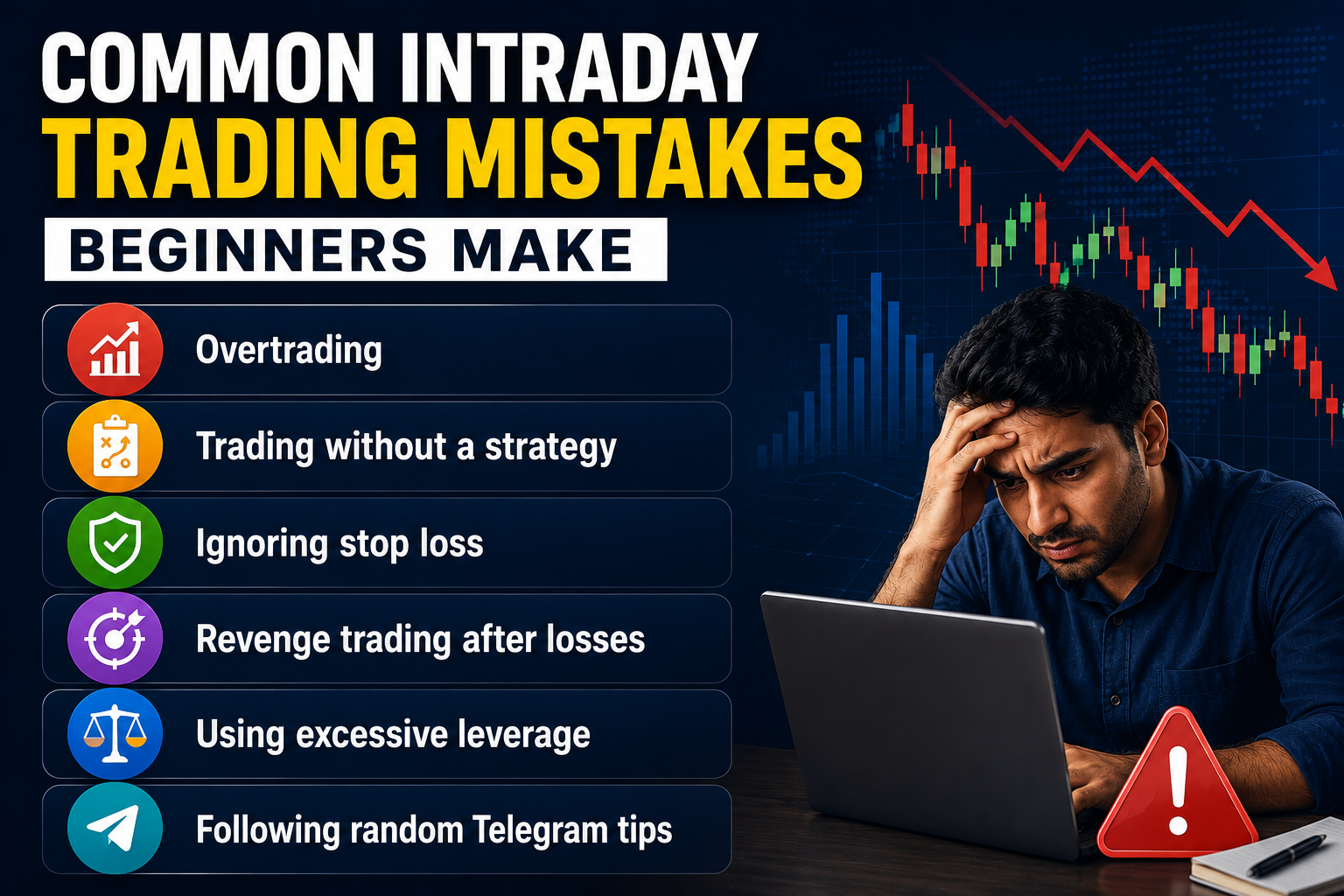
Common mistakes include:
- Overtrading
- Trading without a strategy
- Ignoring stop loss
- Revenge trading after losses
- Using excessive leverage
- Following random Telegram tips
Understanding these mistakes early can save both money and confidence.
A useful resource for beginners is 7 Common Intraday Trading Mistakes & How to Avoid Them.
Best Time for Intraday Trading
The most active market period is usually:
- 9:30 AM to 11:30 AM
During this time:
- Volatility is higher
- Volume is stronger
- Trading opportunities increase
Beginners should avoid random trades near market closing hours.
Is Intraday Trading Profitable in 2026?
Yes, intraday trading can be profitable if done correctly.
However, successful trading requires:
- Patience
- Discipline
- Practice
- Strong risk management
- Emotional control
Most profitable traders focus on consistency rather than trying to earn huge profits quickly.
Final Thoughts
Intraday trading in 2026 offers excellent opportunities for beginners, but success comes from proper learning and disciplined execution.
Instead of chasing quick money:
- Focus on building strong trading habits
- Learn technical analysis
- Practice risk management
- Trade with patience and consistency
The stock market rewards traders who stay disciplined and continue learning.
If you want to improve your skills further, programs like Intraday Trading Mastery and Nifty & Bank Nifty Trading Strategies & Methods can help beginners understand real market strategies in a structured way.
Latest Course





Latest posts





Copyright © By Empirical F&M Academy. Design & Developed by Techno Duniya