
Closing Auction Session (CAS) in India: What Traders Need to Know in 2026
Closing Auction Session (CAS) in India: What Traders Need to Know in 2026
Whether you're a delivery investor, an intraday trader, or you actively trade Futures & Options, understanding CAS is no longer optional — it directly affects your order execution, your settlement price, and your expiry-day P&L. This guide breaks down exactly what CAS is, how it works, and what changes for your trading routine in 2026.
If you're still building your fundamentals in derivatives, our Futures & Options Trading Strategies course is a good place to get comfortable with the basics before layering on a structural change like this.
What Is the Closing Auction Session (CAS)?
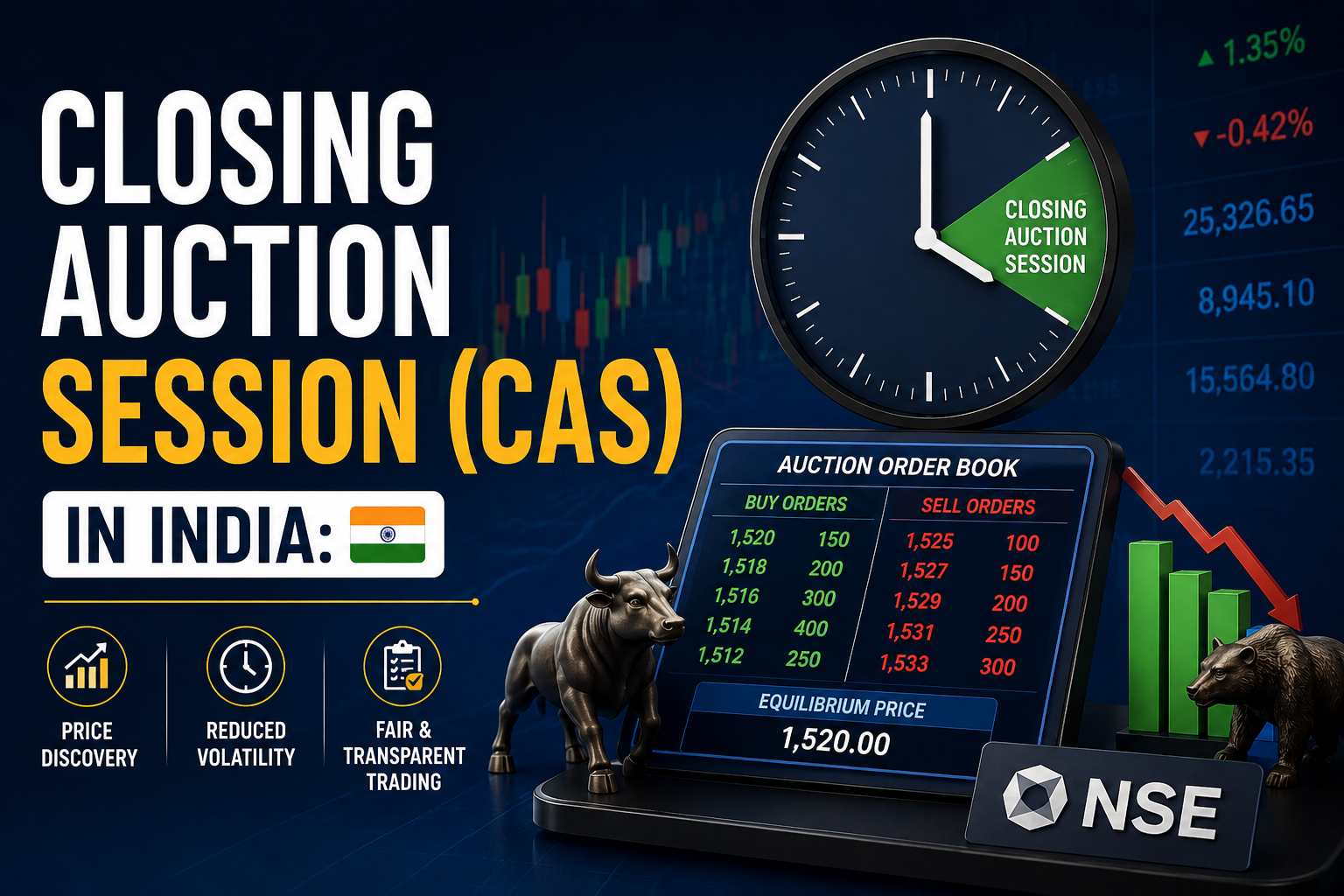
The Closing Auction Session (CAS) is a dedicated auction window introduced by SEBI to determine the official closing price of eligible stocks on India's stock exchanges. Instead of calculating the closing price as an average of trades in the last 30 minutes of the day, CAS collects buy and sell orders in a single pool for a fixed window and matches them at one equilibrium price — the price at which the maximum number of shares can change hands.
This isn't a new idea globally. Exchanges like the NYSE, London Stock Exchange, Euronext, and Hong Kong Exchange have used closing auctions for years. With CAS, India's markets now align more closely with these international best practices.
Why Did SEBI Introduce CAS?
The old method — a 30-minute Volume Weighted Average Price (VWAP) — had a well-known weakness: a handful of large, well-timed orders placed close to market close could distort the average, especially in thinly traded stocks. This made the "official" closing price vulnerable to manipulation, and that closing price matters enormously because it feeds into:
- Index calculations (Nifty, Bank Nifty, Sensex, and sectoral indices)
- F&O contract settlement on expiry
- Mutual fund NAV calculations
- ETF rebalancing and portfolio benchmarking
- Margin and risk management systems used by brokers and exchanges
By replacing the average with an auction, SEBI aims to cut down on closing-price gaming, improve transparency, and give institutional investors — especially passive funds — a genuinely tradable closing price with lower tracking error.
CAS Timeline: How the Last 20–25 Minutes of Trading Work
CAS operates as a separate 20-minute session from 3:15 PM to 3:35 PM on all trading days for CAS-eligible stocks. Here's how it breaks down:
| Time | Phase | What Happens |
|---|---|---|
| 3:00 PM – 3:15 PM | Reference Price Window | Regular trading continues; VWAP of trades in this window sets the auction's reference price |
| 3:15 PM | Continuous Trading Stops | No new orders accepted for CAS-eligible stocks; existing eligible orders carry forward |
| 3:15 PM – 3:30 PM | Order Collection (Auction Phase) | Traders can place, modify, or cancel market and limit orders within the price band |
| 3:30 PM – 3:35 PM | Price Discovery & Matching | Exchange computes the equilibrium price and finalises the official closing price |
| Up to 3:40 PM | Derivatives Trading Continues | F&O contracts on CAS stocks keep trading until 3:40 PM |
Reference Price: Set using the VWAP of trades between 3:00 PM and 3:15 PM.
Price Band: Orders during CAS must stay within ±3% of the reference price.
Allowed Order Types: Only limit orders and market orders. Stop-loss orders and iceberg orders are not permitted during CAS and are automatically excluded from carried-forward orders.
Which Stocks Are Covered Under CAS Right Now?
SEBI is rolling out CAS in phases:
- Category I (Live now): All equity shares that have active Futures & Options (F&O) contracts on NSE or BSE fall under CAS from 3 August 2026.
- Category II (Not yet covered): All other listed stocks continue with the existing closing price methodology — regular trading until 3:30 PM, no auction window — until SEBI expands the framework further.
Always check the exchange's official CAS-eligible securities list, since stocks can move in or out of the F&O segment periodically, which changes their CAS status too.
How CAS Impacts Different Types of Traders
Intraday traders: Continuous trading in CAS-eligible stocks stops at 3:15 PM instead of 3:30 PM — a full 15 minutes earlier than before. If you're used to squaring off intraday positions right up to market close, you'll need to adjust your exit timing and check your broker's revised MIS/intraday auto-square-off cutoffs.
F&O traders: This is the big one. Since the official closing price now comes from the CAS auction rather than the old 30-minute VWAP, your daily mark-to-market (MTM) and expiry-day settlement values are calculated using the new auction price. A stock's CAS closing price can differ meaningfully from where continuous trading last stood at 3:15 PM, so expiry-day risk management deserves fresh attention — something we cover in depth in our breakdown of SEBI's F&O Rules 2026 changes.
Delivery/positional investors: The impact is smaller day-to-day, but since portfolio valuations, index weightings, and NAV calculations all depend on the closing price, CAS indirectly affects how your holdings are marked and benchmarked.
Passive funds, ETFs & institutions: CAS is arguably most valuable here. Because the closing price is now an actual, executable auction price rather than a calculated average, index funds and ETFs can trade at the closing price directly — reducing tracking error significantly.
A Simple Worked Example
Imagine a stock trading quietly around ₹880 for most of the day. In the old system, a burst of trades at ₹862 in the final minutes could pull the 30-minute VWAP — and therefore the "official" close — down toward that distorted level, even if it wasn't representative of genuine demand.
Under CAS, that same late flurry of orders simply becomes part of the auction pool. The exchange looks at the entire pool of buy and sell orders collected between 3:15 PM and 3:30 PM and finds the single price where the maximum number of shares can actually be matched. A handful of orders can no longer single-handedly drag the closing price away from where genuine supply and demand meet.
Key Rules Traders Must Remember
- Continuous trading for CAS stocks ends at 3:15 PM, not 3:30 PM.
- Only limit and market orders are valid during the auction window — no stop-loss or iceberg orders.
- Orders must fall within the ±3% price band of the reference price, or they'll be rejected.
- The final closing price is published shortly after 3:30 PM, typically by 3:35 PM.
- F&O contracts on CAS-eligible underlying stocks continue trading until 3:40 PM.
- Non-F&O stocks are unaffected for now and follow the regular 3:30 PM close.
Getting these mechanics wrong — especially around order types and cut-off times — is an easy way to have valid orders rejected during a live session. If you want structured, hands-on practice with today's market rules rather than piecing it together from scattered notices, our Intraday Trading Course and Nifty & Bank Nifty Trading Strategies course walk through current-session mechanics as part of the curriculum.
CAS vs the Old Closing Price Method
| Parameter | Old Method (Pre-Aug 2026) | Closing Auction Session (CAS) |
|---|---|---|
| Basis of closing price | 30-minute VWAP | Single equilibrium auction price |
| Trading window | Continuous till 3:30 PM | Continuous trading stops at 3:15 PM |
| Vulnerability to late manipulation | Higher | Significantly reduced |
| Order types allowed near close | All order types | Only limit & market orders |
| Global alignment | India-specific | Aligned with NYSE, LSE, Euronext model |
| Applicability (2026) | All stocks | Only F&O-eligible stocks (Category I) |
Frequently Asked Questions
Q1. When did CAS start in India?
CAS went live on NSE and BSE on 3 August 2026 for all equity shares with active F&O contracts.
Q2. Does CAS apply to all stocks?
No. Currently, only Category I stocks — those with F&O contracts — are covered. Other stocks continue with the previous methodology until SEBI extends CAS further.
Q3. Can I place a stop-loss order during CAS?
No. Only limit orders and market orders are permitted during the Closing Auction Session; stop-loss and iceberg orders are excluded.
Q4. How is the CAS reference price calculated?
It's the VWAP of trades executed between 3:00 PM and 3:15 PM, and the auction price must stay within ±3% of this reference price.
Q5. Does CAS change intraday square-off timing?
Yes — since continuous trading for CAS-eligible stocks stops at 3:15 PM, intraday and MIS positions in these stocks must typically be squared off earlier than before. Confirm exact cutoffs with your broker.
Final Thoughts
CAS represents one of the most significant structural upgrades to India's equity markets in recent years — a move toward a more transparent, manipulation-resistant, and globally aligned closing price mechanism. For active F&O traders in particular, understanding the new 3:15–3:35 PM window isn't optional homework; it's now part of the daily trading routine.
Markets don't stand still, and rules like CAS are exactly why continuously updating your trading knowledge matters. To go deeper into how recent SEBI reforms are reshaping strategy and risk management, read our guide on why retail traders lose money in F&O in 2026, or explore our full range of stock market and F&O courses at Empirical F&M Academy to trade the new market structure with confidence.
Disclaimer: This article is for educational purposes only and does not constitute investment advice. Always verify live CAS rules, timings, and eligible securities with NSE/BSE and your broker before trading.
Latest Course





Latest posts




Copyright © By Empirical F&M Academy. Design & Developed by Techno Duniya