
Financial Analysis Course: The Complete Guide to Choosing the Right Program in 2026
Financial Analysis Course: The Complete Guide to Choosing the Right Program in 2026
It's the foundation skill behind equity research, portfolio management, investment banking, and serious retail investing.
If you've typed "financial analysis course" into Google, you're probably trying to answer one of three questions: What does this course actually teach? Do I need one to invest well? Which one should I join? This guide answers all three, and by the end you'll know exactly what to look for before you enroll.
What Is Financial Analysis, Exactly?
Financial analysis is the process of examining a company's financial statements — the balance sheet, profit & loss statement, and cash flow statement — to understand its financial health and estimate what the business (and its stock) is actually worth.
It typically combines two approaches:
- Fundamental analysis — studying a company's business model, management quality, industry position, and financial ratios to judge its long-term value.
- Technical analysis — studying price charts and trading volumes to time entries and exits.
A structured financial analysis course usually focuses on the fundamental side, since that's what drives long-term investment decisions, valuation, and equity research careers. If you want the chart-reading side of the market instead, that's covered separately in a Technical Analysis course.
Why Learn Financial Analysis?
You don't need to be an aspiring analyst to benefit from this skill. Here's who actually uses it:
- Retail investors who want to stop relying on stock tips and start reading balance sheets themselves.
- Finance and commerce students building job-ready skills before campus placements.
- Working professionals eyeing a shift into equity research, investment banking, or portfolio management.
- Business owners who want to understand their own company's financial statements better.
In every one of these cases, the payoff is the same: you stop guessing and start making decisions based on numbers.
What a Good Financial Analysis Course Should Cover
Not all courses are built the same. A financial analysis program worth your time and money should walk you through these core modules:
1. Reading Financial Statements
How to interpret the balance sheet, income statement, and cash flow statement — and how the three connect to each other.
2. Ratio Analysis
Profitability ratios, liquidity ratios, solvency ratios, and efficiency ratios — and, more importantly, how to compare them against industry peers rather than looking at them in isolation.
3. Valuation Techniques
Core valuation methods such as discounted cash flow (DCF), price-to-earnings (P/E), and price-to-book (P/B) comparisons, used to estimate whether a stock is undervalued or overvalued.
4. Industry and Competitive Analysis
Understanding how a company's sector, competitive position, and macroeconomic environment affect its financial performance.
5. Practical, Real-Stock Application
The best courses don't stop at theory. Look for programs that make you analyse live Indian companies and build your own valuation models, not just watch recorded lectures.
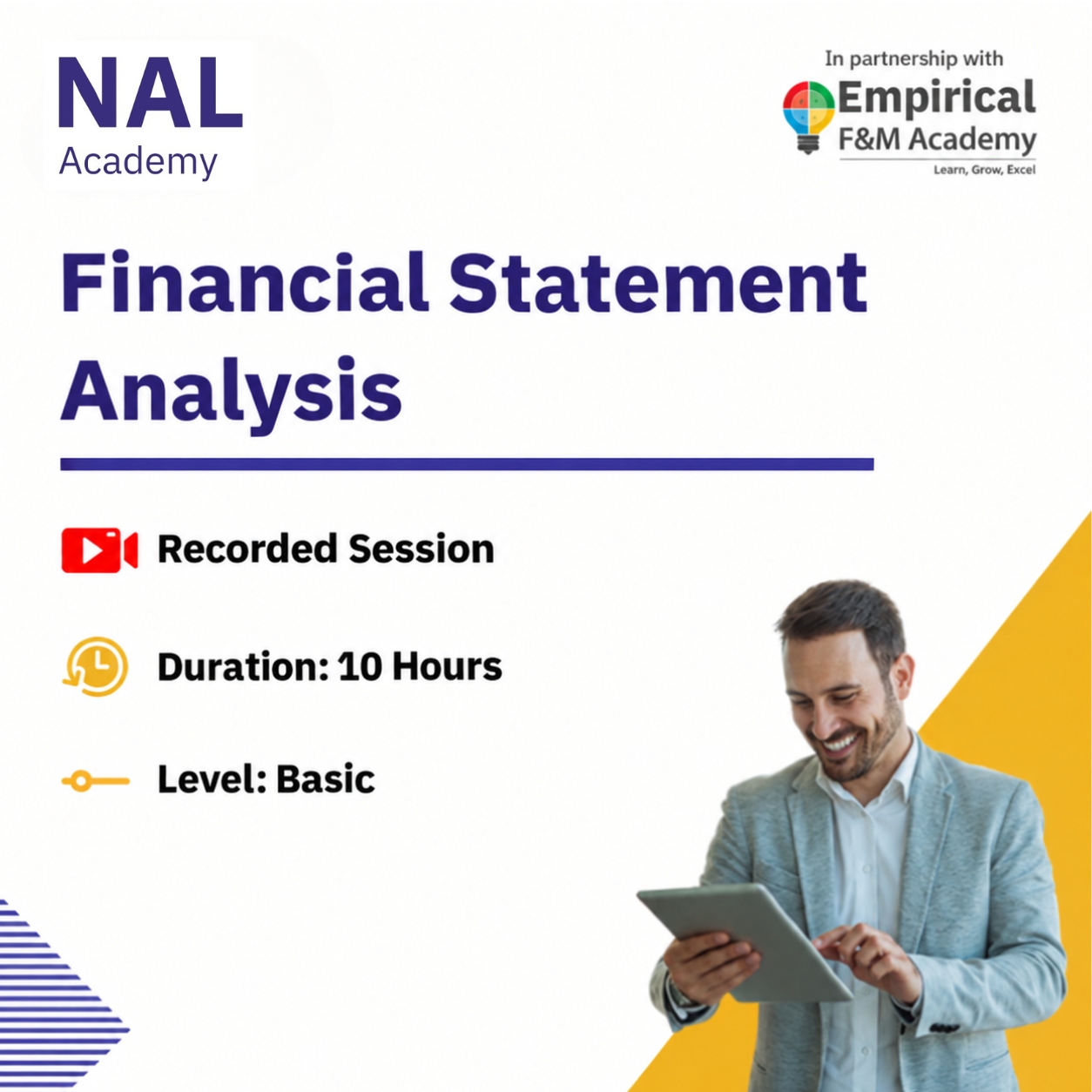
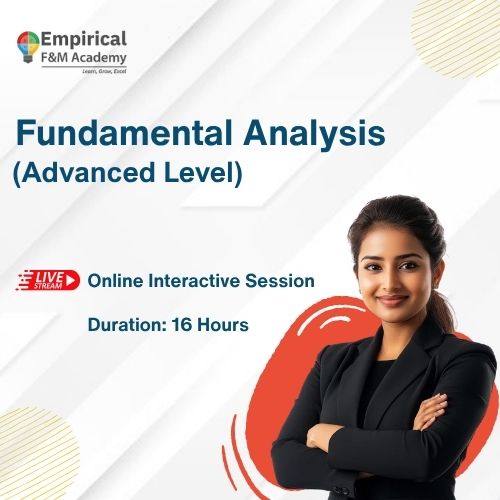
This is exactly the structure followed in Empirical F&M Academy's Fundamental Analysis course, which takes you from financial statement basics to real stock evaluation, and the more advanced Fundamental Analysis (Basic + Advanced) track for those who want to go deeper into valuation modelling.
Financial Analysis vs. Equity Research: What's the Difference?
People often use these terms interchangeably, but there's a practical distinction:
- Financial analysis is the skill — reading statements, calculating ratios, building valuation models.
- Equity research is the applied version of that skill — using financial analysis to research a stock, form an investment thesis, and produce a research report or recommendation.
If your goal is to eventually work as a research analyst or manage a portfolio professionally, the natural next step after a financial analysis course is the Equity Research and Valuation course, which builds directly on these fundamentals with sector-specific valuation and report-writing practice.
How to Choose the Right Financial Analysis Course
Use this checklist before you enroll anywhere:
- Curriculum depth — Does it cover ratio analysis and valuation, or just definitions?
- Practical application — Will you analyse real, live Indian companies, or only theoretical examples?
- Instructor credibility — Are the trainers practising analysts or full-time educators with market experience?
- Certification value — Is the certificate recognised, and does it strengthen your resume?
- Support after the course — Do you get mentorship or doubt-clearing once the sessions end?
- Format flexibility — Can you attend live sessions, or revisit recorded classes if you miss one?
Empirical F&M Academy's courses are built around this exact checklist — practical, mentor-led, and backed by industry-recognised certification, with both live and recorded access so you can learn at your own pace.
Career Paths After a Financial Analysis Course
A solid grounding in financial analysis opens doors to several roles:
- Equity Research Analyst
- Investment Banking Analyst
- Portfolio Manager / Wealth Manager
- Credit Analyst
- Corporate Finance Executive
- Independent/Retail Investor managing your own portfolio confidently
Many learners pair their financial analysis foundation with a Technical Analysis or Futures & Options Trading course afterward, so they can combine long-term valuation skills with shorter-term market timing.
Frequently Asked Questions
Q1. Is a financial analysis course useful for beginners with no finance background?
Yes. A well-structured course starts from the basics of reading a balance sheet and P&L statement before moving into ratios and valuation, so no prior finance degree is required.
Q2. How long does it take to learn financial analysis?
Foundation-level courses typically run 10–12 hours of structured learning, while combined basic-plus-advanced tracks can extend to 25+ hours for deeper valuation and modelling practice.
Q3. Can I learn financial analysis online?
Yes. Most reputable institutes, including Empirical F&M Academy, offer both live online sessions and recorded content with lifetime access, so you can learn on your own schedule.
Q4. Do I need to know accounting before joining?
No. A good course teaches you the accounting concepts you need as part of the curriculum — you don't need a prior accounting or commerce background.
Q5. Will I get a certificate after completing the course?
Yes, learners receive a certificate upon completion, which can be added to your resume or LinkedIn profile as proof of your financial analysis skills.
Q6. What's the difference between fundamental analysis and financial analysis? Financial analysis is the broader skill of evaluating financial statements and ratios. Fundamental analysis applies that skill specifically to judge whether a stock is a good investment.
Ready to Build This Skill Properly?
Reading about financial analysis only gets you so far — the real learning happens when you start applying it to actual company financials. Explore the Fundamental Analysis course or the complete range of Empirical F&M Academy courses, or get in touch with our team to find the program that fits your goals. You can also browse more guides like this on our blog.
Latest Course



Latest posts




Copyright © By Empirical F&M Academy. Design & Developed by Techno Duniya