Algo Trading Course in India (2026): Complete Guide
Algo Trading Course in India (2026): Complete Guide
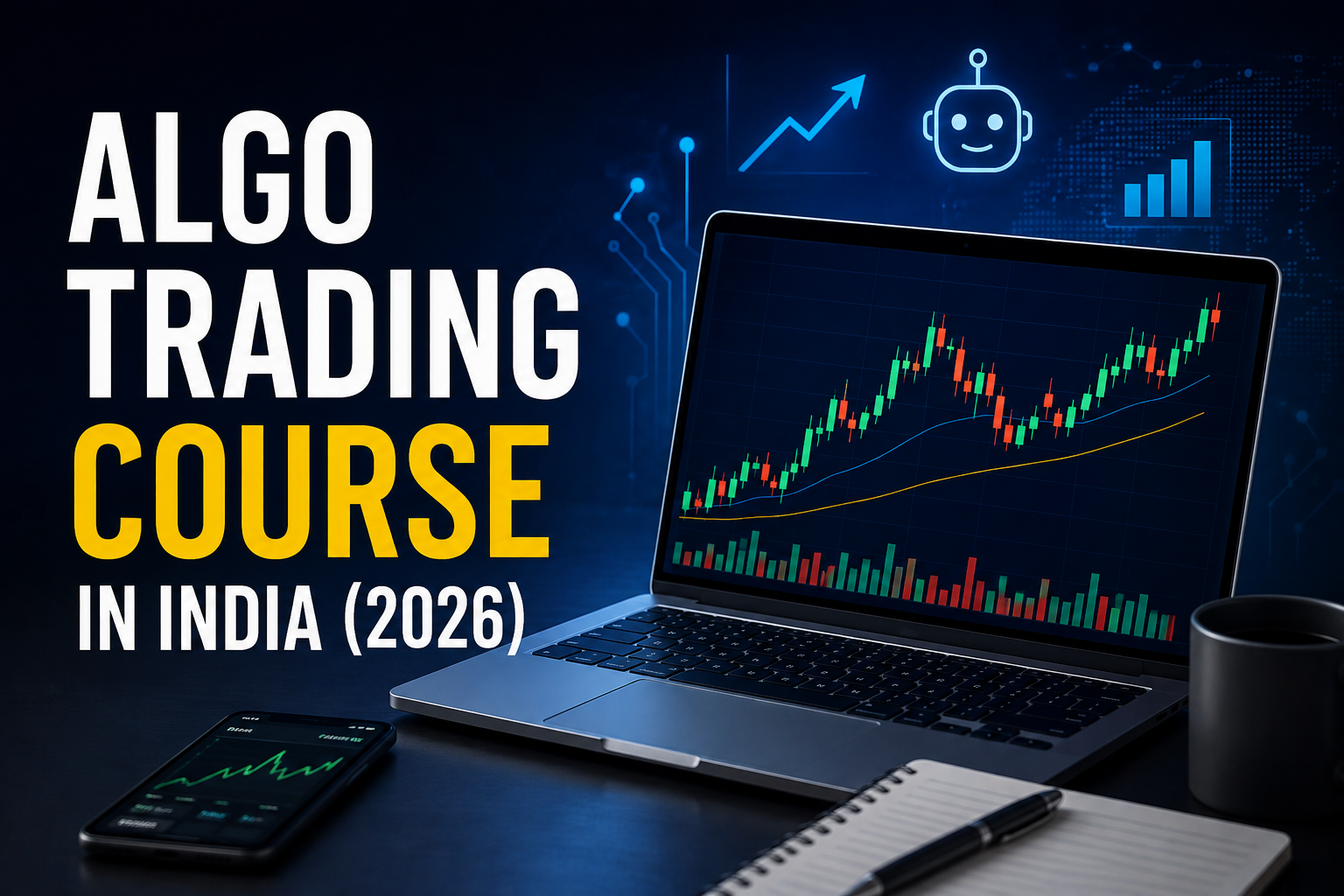
A good algo trading course teaches you how to design these rules, code them (usually in Python), backtest them on historical data, and deploy them through a broker API. This guide breaks down exactly what such a course should cover, who it's for, and how to choose one that actually gets you trading — not just watching lectures.
What Is Algorithmic Trading, Really?
Algorithmic trading replaces manual order placement with a program that watches the market and acts the moment your conditions are met. Instead of staring at charts all day, you define the logic once — for example, "buy when the 9-period moving average crosses above the 21-period moving average" — and the system executes it faster and more consistently than any human could.
It's already the backbone of modern markets. Institutional desks, proprietary trading firms, and a fast-growing number of retail traders in India now rely on algorithms for everything from simple rule-based entries to complex multi-leg options strategies.
Why Learn Algo Trading Now
Three shifts have made this the right time to build this skill:
- Broker APIs are now retail-friendly. Platforms like Zerodha Kite, Angel One SmartAPI, and Fyers give individual traders the same programmatic access that was once limited to institutions.
- Python has made coding accessible. You no longer need a computer science degree — basic Python plus market knowledge is enough to build a working strategy.
- Discretionary trading has a bias problem. Fear, greed, and hesitation cost traders money. Automated systems execute the plan exactly as backtested, every single time.
Who Should Take an Algo Trading Course?
You don't need to be a programmer or a finance professional to start. An algo trading course is built for:
- Discretionary traders who want to remove emotional decision-making from execution
- Working professionals looking to build a systematic side-income stream from the market
- Finance and commerce students who want a practical, in-demand skill beyond textbook theory
- Tech enthusiasts and developers curious about applying coding skills to real financial markets
- Anyone asking "how do I start algo trading in India" with zero prior background
What a Good Algo Trading Course Should Actually Teach
Plenty of courses sell the buzzword. Very few teach the full pipeline. Before enrolling anywhere, check that the curriculum covers all of these:
- Trading and market fundamentals — order types, market structure, and risk management, so the "why" behind every rule is clear
- Python for algorithmic trading — from basic syntax to using libraries for data handling and strategy logic
- Strategy design — building rule-based entries and exits around trend-following, mean-reversion, or momentum logic
- Backtesting — testing a strategy against historical data before risking real capital
- Broker API integration — connecting your code to a live trading account to place real orders
- Bot deployment — running your strategy on live market data with proper monitoring
- No-code options — for non-programmers, tools that let you build and automate strategies without writing scripts
If a course skips backtesting or API integration, you're only getting half the picture — theory without the ability to actually run anything live.
Skills You'll Walk Away With
By the end of a well-structured algo trading course, you should be able to:
- Read and write Python scripts for trading logic
- Backtest a strategy and interpret metrics like drawdown and win rate
- Connect a trading account to a broker API
- Build and monitor a live automated strategy
- Adapt strategies across equity, futures & options, and index markets
How to Choose the Best Algo Trading Course in India
Use this checklist before you pay for any program:
|
What to Check |
Why It Matters |
|
Beginner-friendly Python modules |
You shouldn't need prior coding experience to start |
|
Real datasets, not just demo data |
Practicing on actual market data builds real confidence |
|
Live API and bot deployment |
Theory alone won't get a strategy into the market |
|
Mentorship from active traders |
Faculty who trade, not just teach, catch real-world gaps |
|
Self-paced + lifetime access |
Markets evolve — you'll want to revisit material later |
|
Recognized certification |
Adds credibility for jobs, freelancing, or client work |
Mastering Algorithmic Trading at Empirical Academy
Empirical Academy's Algo Trading Course is built around this exact framework theory, execution, and mentorship, in that order.
Here's what the program covers:
- Python for algorithmic trading, taught from the ground up so even complete beginners can follow along
- Building your own trading bots and backtesting them against real market data
- Broker API integration, so you can move strategies from backtest to live execution
- A mix of coding and no-code tools, making the course accessible whether you're technical or not
- Self-paced learning with lifetime access, so you can revisit modules as markets and strategies evolve
Empirical Academy has trained 25,000+ students across its trading programs, with faculty who work as active traders and mentors — not just instructors reading off slides. If you're also exploring options strategies or technical setups, you can pair this with the Mastering Options Trading or Technical Trading Lab programs to build a more complete trading skill set.
Career and Income Opportunities After an Algo Trading Course
Learning algo trading opens more than one path:
- Personal trading — automate your own strategies and remove manual execution errors
- Quant/algo trading roles — an increasingly in-demand skill set at brokerages, prop desks, and fintech firms
- Freelance strategy building — build and sell custom bots or strategies for other traders
- Fintech and analytics careers — the Python and data skills transfer directly into broader finance-tech roles
Frequently Asked Questions
Q1. Do I need coding experience to take an algo trading course?
No. A well-designed course starts with Python basics, so beginners with zero coding background can follow the modules and still build a working strategy by the end.
Q2. Is algo trading legal for retail traders in India?
Yes. Retail algo trading is legal when executed through SEBI-registered brokers using their approved APIs, following the exchange guidelines applicable to individual traders.
Q3. Can I learn algo trading without writing any code?
Partially. Many strategies can be built using no-code tools, but understanding basic Python gives you far more flexibility to customize and troubleshoot your strategies.
Q4. How long does it take to learn algo trading?
With a structured, self-paced course, most learners can build and backtest their first working strategy within a few weeks, depending on the time they can dedicate weekly.
Q5. What is the difference between algo trading and manual trading?
Manual trading relies on a trader's real-time judgment and execution speed, while algo trading uses pre-programmed rules that execute automatically the moment conditions are met — with no emotional interference.
Q6. Is an algo trading course worth it for beginners?
Yes, if the course covers the full pipeline- fundamentals, Python, backtesting, and live API deployment — rather than just theory. That's what separates a useful course from a surface-level one.
Ready to Build Your First Trading Bot?
Automated trading isn't just for institutions anymore. With the right course, you can go from zero coding background to a live, backtested strategy running on real market data.
Explore the Algo Trading Course at Empirical Academy
Latest Course
Latest posts




Copyright © By Empirical F&M Academy. Design & Developed by Techno Duniya