
Bank Nifty Trading Strategy for Beginners: Complete Guide (2026)

Bank Nifty Trading Strategy for Beginners: Complete Guide (2026)
Bank Nifty is an index of the 12 most liquid and large banking stocks listed on the NSE, and it is one of the most actively traded indices in India due to its high volatility, tight spreads, and weekly options expiry.
For beginners, Bank Nifty offers strong liquidity and clear technical structure, but its fast moves also mean mistakes can be costly without a plan. This guide walks through beginner-friendly strategies, risk rules, and common pitfalls to avoid.
If you're completely new to trading, start with How to Become a Stock Market Trader in India before diving into index-specific strategies.
Why Bank Nifty Is Popular Among Traders
- High liquidity — tight bid-ask spreads make entries and exits efficient
- High volatility — larger intraday moves create more trading opportunities than many individual stocks
- Weekly options — frequent expiries attract active options traders
- Sensitivity to macro events — RBI policy, interest rate decisions, and banking sector news drive sharp moves
- Correlation with top banks — HDFC Bank, ICICI Bank, SBI, Axis Bank, and Kotak Mahindra Bank make up the bulk of its weight
Before You Trade Bank Nifty: Foundational Skills You Need
Bank Nifty's speed punishes traders who skip the basics. Make sure you're comfortable with:
- Reading candlestick charts — see How to Read Candlestick Charts: 15 Patterns
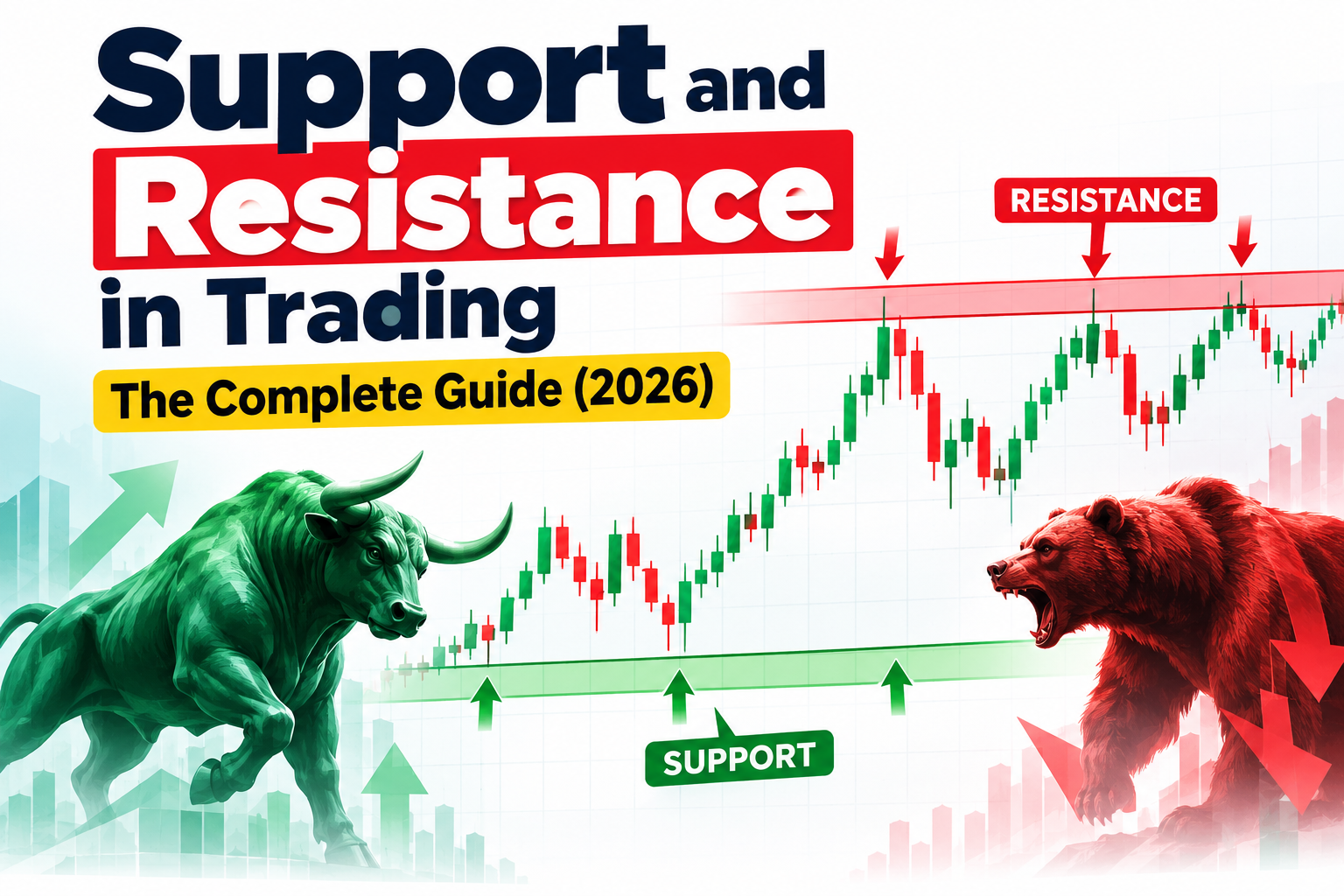
- Identifying support and resistance — see Support and Resistance in Trading
- Using indicators for confirmation — see Best Technical Indicators for Intraday Trading (2026 Guide)
- Managing risk on every trade — see Risk Management in Trading
5 Bank Nifty Trading Strategies for Beginners
1. Opening Range Breakout (ORB)
Mark the high and low of the first 15–30 minutes of trade. A decisive break above the range high, ideally with volume, signals a long entry; a break below the range low signals a short. Keep the stop loss at the opposite end of the range.
2. Previous Day High/Low Strategy
The previous session's high and low often act as strong intraday support and resistance for Bank Nifty. Watch for rejection or breakout behavior around these levels at the start of the session.
3. VWAP Strategy
The Volume Weighted Average Price (VWAP) acts as a dynamic intraday level. Price trading above VWAP signals bullish control; below VWAP signals bearish control. Many traders buy on pullbacks to VWAP in an uptrend and sell on rallies to VWAP in a downtrend.
4. Moving Average Crossover
Using a combination like the 9-period and 21-period EMA on a 5 or 15-minute chart, a bullish crossover (short EMA crossing above the longer EMA) can signal trend continuation to the upside, and vice versa for a bearish crossover. Always confirm with price structure rather than relying on the crossover alone.
5. Option Chain-Based Levels
Strikes with heavy Put open interest are often read as support, while strikes with heavy Call open interest are often read as resistance. This is especially useful around weekly expiry when option writers defend key strikes.
Bank Nifty Options Trading for Beginners
Options are a popular way to trade Bank Nifty due to lower capital requirements compared to futures. Key basics beginners must understand:
- Buying options (Calls or Puts) has limited, defined risk — you can only lose the premium paid.
- Selling (writing) options carries higher, potentially unlimited risk and generally requires more capital, margin, and experience.
- Time decay (theta) works against option buyers, especially closer to expiry — a factor that matters more with Bank Nifty's weekly expiry cycle.
- Implied volatility (IV) affects premiums; buying options when IV is very high can be expensive even if your directional view is correct.
Beginners are generally better served starting with simple, defined-risk option buying strategies before exploring option selling or spreads. Our Trade Smart Using Futures and Options (Basic) course is built specifically for this starting point.
Risk Management Rules Specific to Bank Nifty
Bank Nifty's volatility means risk discipline matters even more than in slower-moving stocks:
- Risk only 0.5–1% of capital per trade, given how fast Bank Nifty can move against you.
- Always define your stop loss before entering, based on the opening range, VWAP, or a key support/resistance zone.
- Avoid trading the first 5–10 minutes after market open, when Bank Nifty is most volatile and levels are still forming.
- Be cautious around RBI policy days and major banking sector news — consider reducing position size or staying out entirely.
- Set a hard daily loss limit and stop trading once it's hit.
For the complete framework, read Risk Management in Trading.
A Simple Beginner Bank Nifty Trading Checklist
- Check the previous day's high, low, and close before the market opens.
- Note key support and resistance zones on the daily chart.
- Wait for the opening 15–30 minutes to establish the day's range.
- Look for confirmation from VWAP, moving averages, or candlestick patterns before entering.
- Define your stop loss and target before placing the trade.
- Size your position based on 0.5–1% risk, not on how much margin is available.
- Respect your daily loss limit — stop once it's reached.
- Journal the trade: entry, exit, reasoning, and outcome.
Common Mistakes Beginners Make with Bank Nifty
- Overtrading due to Bank Nifty's frequent intraday swings.
- Ignoring the opening volatility and entering trades too early.
- Buying deep out-of-the-money options hoping for a cheap lottery-style win.
- No stop loss, especially in fast-moving option premiums.
- Overleveraging with futures or large option lot sizes beyond their risk capacity.
- Trading through major news events (RBI policy, Union Budget) without adjusting size or sitting out.
- Revenge trading after a loss instead of following the daily loss limit.
Bank Nifty Trading Strategy Quick Reference
| Strategy | Best Used When | Key Tool |
|---|---|---|
| Opening Range Breakout | Early session, trending days | First 15–30 min high/low |
| Previous Day High/Low | Start of session | Prior session levels |
| VWAP Strategy | Trending intraday sessions | VWAP line |
| Moving Average Crossover | Confirming trend direction | 9 & 21 EMA |
| Option Chain Levels | Near weekly expiry | Put/Call OI data |
Frequently Asked Questions (FAQs)
Q1. What is the best strategy for Bank Nifty trading for beginners?
The Opening Range Breakout and Previous Day High/Low strategies are among the most beginner-friendly, since they rely on clear, objective levels rather than subjective chart reading.
Q2. Is Bank Nifty good for beginners?
Bank Nifty can be traded by beginners, but its high volatility means new traders should start with small position sizes, strict stop losses, and simple strategies before increasing capital.
Q3. Should beginners buy or sell Bank Nifty options?
Beginners are generally better suited to buying options, since the risk is limited to the premium paid, whereas selling options carries higher risk and requires more capital and experience.
Q4. What is the best time to trade Bank Nifty intraday?
Many traders avoid the first 5–10 minutes after market open due to high volatility, and instead look for setups once the opening range and early trend are established.
Q5. How much capital do I need to trade Bank Nifty options?
Capital requirements vary by strategy and lot size, but beginners should ensure their risk per trade is small relative to their total capital, generally 0.5–1%, rather than focusing only on the premium or margin required.
Q6. Does Bank Nifty move with RBI policy announcements?
Yes, Bank Nifty is highly sensitive to RBI monetary policy, interest rate decisions, and banking sector regulations, and these events often cause sharp, fast price moves.
Key Takeaways
- Bank Nifty's liquidity and volatility make it a popular but demanding index for beginners.
- Build core skills first: candlesticks, support/resistance, indicators, and risk management.
- Use objective, rule-based strategies like ORB and VWAP rather than guesswork.
- Risk only a small percentage of capital per trade and respect a daily loss limit.
- Start with simple, defined-risk option buying before exploring more advanced strategies
Learn Bank Nifty Trading the Practical Way
Trading Bank Nifty successfully takes more than knowing the strategies — it requires live, guided practice. At Empirical F&M Academy, certified trainers teach index trading, options basics, and risk management through interactive sessions.
- Start with Nifty & Bank Nifty Trading Strategies & Methods, built specifically for index traders
- New to options? Begin with Trade Smart Using Futures and Options (Basic)
- Build your charting foundation with Trade Smart Using Technical Analysis
- See the complete course catalogue at Empirical F&M Academy
- Questions? Contact our team
Disclaimer: This article is for educational purposes only and is not investment advice. Trading in index derivatives carries high risk, including the risk of loss of the entire premium in options and significant losses in futures. Please consult a SEBI-registered advisor before making financial decisions.
Latest Course





Latest posts




Copyright © By Empirical F&M Academy. Design & Developed by Techno Duniya