
Risk Management in Trading: The Complete Guide (2026)
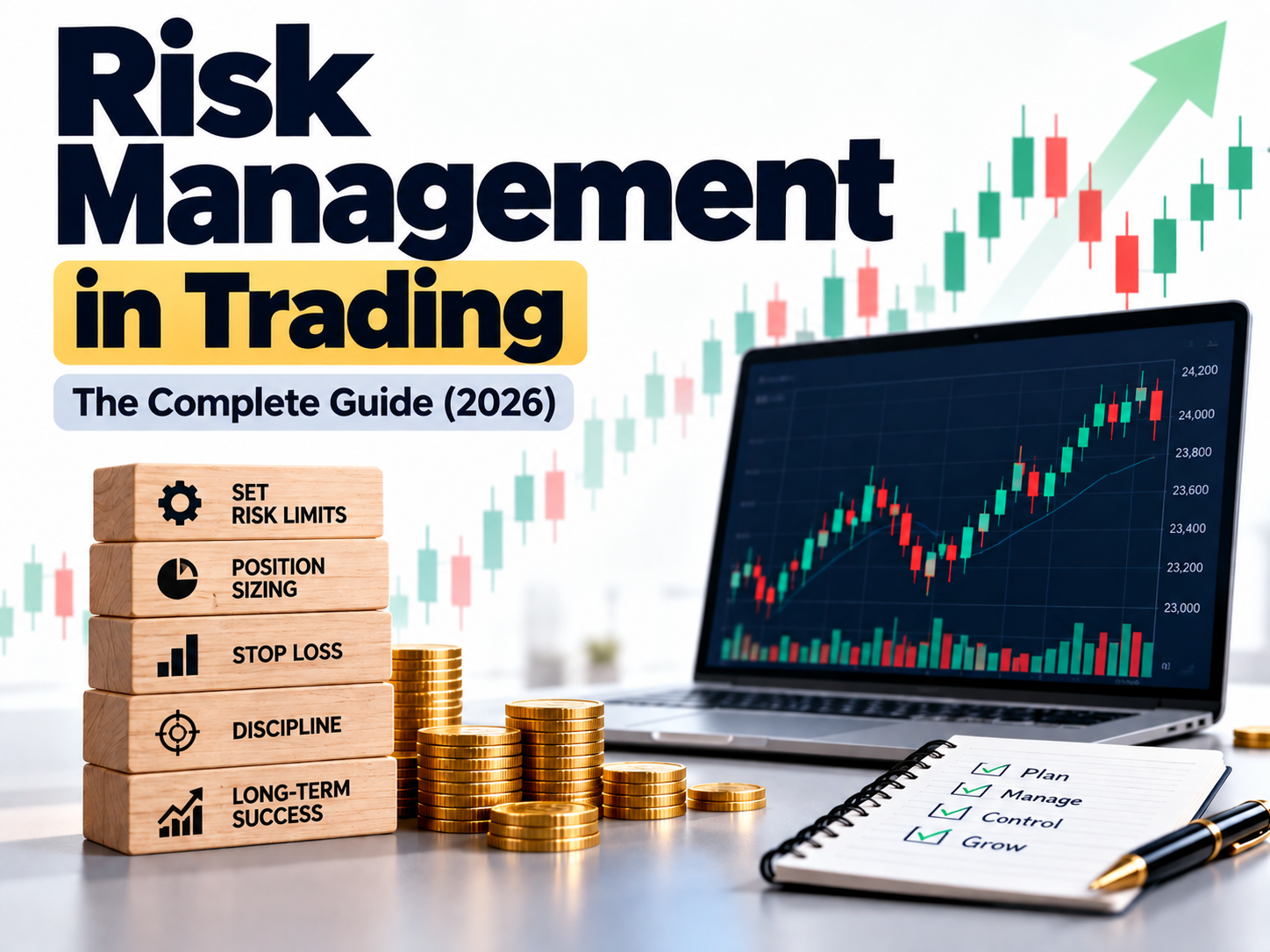
Risk Management in Trading: The Complete Guide (2026)
Risk management in trading is the process of controlling how much capital you can lose on any single trade, so that no one loss, or series of losses, can seriously damage your trading account.
It is not about avoiding risk entirely. Every trade carries risk. Risk management is about sizing that risk correctly, defining it before you enter, and staying consistent no matter how confident you feel about a trade.
Most traders lose money not because they pick bad trades, but because they manage risk poorly. A trader with an average strategy and strict risk management will usually outlast a trader with a brilliant strategy and no risk control.
If you're still building your foundation, start with our How to Learn Stock Market Trading in India: Complete Roadmap (2026) before applying these risk rules.
Why Risk Management Matters More Than Strategy
- Markets are probabilistic. No strategy wins every time. Even a 70% win-rate strategy will have losing streaks.
- One large loss can undo dozens of wins. A single unmanaged trade can wipe out weeks of gains.
- Emotions follow losses. Poor risk control leads to revenge trading and panic decisions.
- Capital preservation buys you time. As long as you have capital, you can keep trading and improving. Without it, you're out of the game
Core Principles of Risk Management in Trading
1. The 1% (or 2%) Rule
Never risk more than 1–2% of your total trading capital on a single trade. On a ₹5,00,000 account, a 1% risk means you should lose no more than ₹5,000 if the trade goes wrong.
2. Always Use a Stop Loss
A stop loss is a predefined exit point that limits your loss. Set it before entering the trade, not after. Place it based on chart structure, such as just beyond a support or resistance zone. For a deeper look at identifying these zones, see our guide on Support and Resistance in Trading.
3. Position Sizing
Position size should be calculated from your stop loss distance and risk percentage, not from how much you "feel like" buying.
Formula:
Position Size = (Account Capital × Risk %) ÷ (Entry Price − Stop Loss Price)
Example: Capital ₹5,00,000, risk 1% (₹5,000), entry ₹100, stop loss ₹95 (₹5 risk per share) → Position size = ₹5,000 ÷ ₹5 = 1,000 shares.
4. Risk-to-Reward Ratio
Only take trades where the potential reward is meaningfully larger than the risk, typically at least 1:2. This means even a strategy that wins less than half the time can still be profitable.
5. Diversification
Avoid putting your entire capital into one stock, sector, or single directional bet. Spread exposure across uncorrelated positions where possible.
6. Maximum Daily and Weekly Loss Limits
Set a hard stop for the day or week, for example 3% of capital. If you hit it, stop trading and reassess rather than trying to "win it back."
7. Avoid Overleveraging
Leverage in F&O and intraday trading amplifies both gains and losses. Use leverage cautiously, and always size positions on your actual risk, not just the margin available.
Risk Management for Intraday Trading
Intraday trading requires tighter risk control because positions must be closed the same day and moves can be fast:
- Define your stop loss and target before entering, using levels like the previous day's high/low or opening range.
- Risk a smaller percentage per trade (often 0.5–1%) since intraday setups are more frequent.
- Track a running daily loss limit and walk away once it's hit.
- Avoid trading the first few minutes of market open, when volatility is highest and levels are still forming.
To build this into a structured plan, explore the Best Intraday Trading Course Online, or go deeper with Nifty & Bank Nifty Trading Strategies & Methods.
Risk Management in Futures & Options (F&O)
F&O trading carries unique risks due to leverage, time decay, and volatility:
- Options buyers should size positions by premium at risk, not by lot size alone.
- Options sellers face theoretically unlimited risk on naked positions and must use hedges or defined-risk spreads.
- Futures traders should account for margin, mark-to-market losses, and gap risk overnight.
- Always know your maximum possible loss on a position before entering it.
Our Trade Smart Using Futures and Options (Basic) course covers position sizing and hedging specific to derivatives.
Psychological Risk Management
Risk management isn't only mathematical. It's behavioral:
- Accept losses as a cost of doing business. They are not personal failures.
- Don't move your stop loss further away to avoid taking a loss.
- Don't increase position size after a loss to "make it back" faster.
- Journal every trade, including why you entered, your risk, and the outcome.
- Review weekly, not just after big wins or losses, to spot patterns in your behaviour
Common Risk Management Mistakes Traders Make
- Trading without a stop loss.
- Risking too much capital on a single "high conviction" trade.
- Averaging down on a losing position instead of respecting the original stop.
- Ignoring correlation, holding multiple positions that all move together.
- Changing risk rules mid-trade based on emotion.
- Not accounting for overnight or weekend gap risk in F&O positions.
- Overtrading after a loss to recover quickly.
Risk Management Quick Reference
| Element | Guideline |
|---|---|
| Risk per trade | 1–2% of total capital |
| Stop loss | Set before entry, based on chart structure |
| Risk-reward ratio | Minimum 1:2 |
| Daily loss limit | 2–3% of capital |
| Leverage | Use cautiously, size by actual risk |
| Position sizing | Calculated from stop loss distance, not gut feel |
Frequently Asked Questions (FAQs)
Q1. What is risk management in trading?
Risk management in trading is the practice of controlling how much of your capital you can lose on any trade through position sizing, stop losses, and predefined risk limits, so that losses stay small and manageable.
Q2. What is the 1% rule in trading?
The 1% rule means risking no more than 1% of your total trading capital on any single trade, which helps protect your account from large drawdowns even during losing streaks.
Q3. How do you calculate position size based on risk?
Divide your risk amount in rupees (capital multiplied by risk percentage) by the difference between your entry price and stop loss price to get the number of shares or lots to trade.
Q4. What is a good risk-reward ratio in trading?
A risk-reward ratio of at least 1:2 is generally considered good, meaning your potential profit target is at least twice your potential loss.
Q5. Why do most traders fail at risk management?
Most traders fail because they trade without a predefined stop loss, risk too much on single trades, or abandon their risk rules emotionally after a loss or a win.
Q6. Is risk management more important than strategy?
Yes, in practice. A mediocre strategy with strict risk management can survive and grow over time, while even a strong strategy without risk management can wipe out an account in a few bad trades.
Q7. How much should I risk per trade in intraday trading?
Many intraday traders risk 0.5–1% of capital per trade, given the higher frequency of trades and tighter stop losses used in intraday setups.
Key Takeaways
- Risk management protects your capital so you can stay in the market long enough to improve.
- Always define your stop loss and position size before entering a trade.
- Aim for a minimum 1:2 risk-reward ratio.
- Set daily and weekly loss limits, and respect them without exception.
- Combine technical setups, like support and resistance, with disciplined risk rules for consistent results.
Learn Risk Management the Practical Way
Knowing the rules is not the same as applying them under real market pressure. At Empirical F&M Academy, our certified trainers teach position sizing, stop loss placement, and portfolio-level risk control through live, practical sessions.
- Explore Trade Smart Using Technical Analysis to combine chart-based entries with sound risk rules
- Trading derivatives? Start with Trade Smart Using Futures and Options (Basic)
- See the full course catalogue at Empirical F&M Academy
- Questions? Contact our team
Disclaimer: This article is for educational purposes only and is not investment advice. Trading and investing in securities involves risk, including loss of capital. Please consult a SEBI-registered advisor before making financial decisions.
Latest Course



Latest posts


Copyright © By Empirical F&M Academy. Design & Developed by Techno Duniya