Options Trading for Beginners: The Complete Guide to Calls, Puts & Strategies (2026)
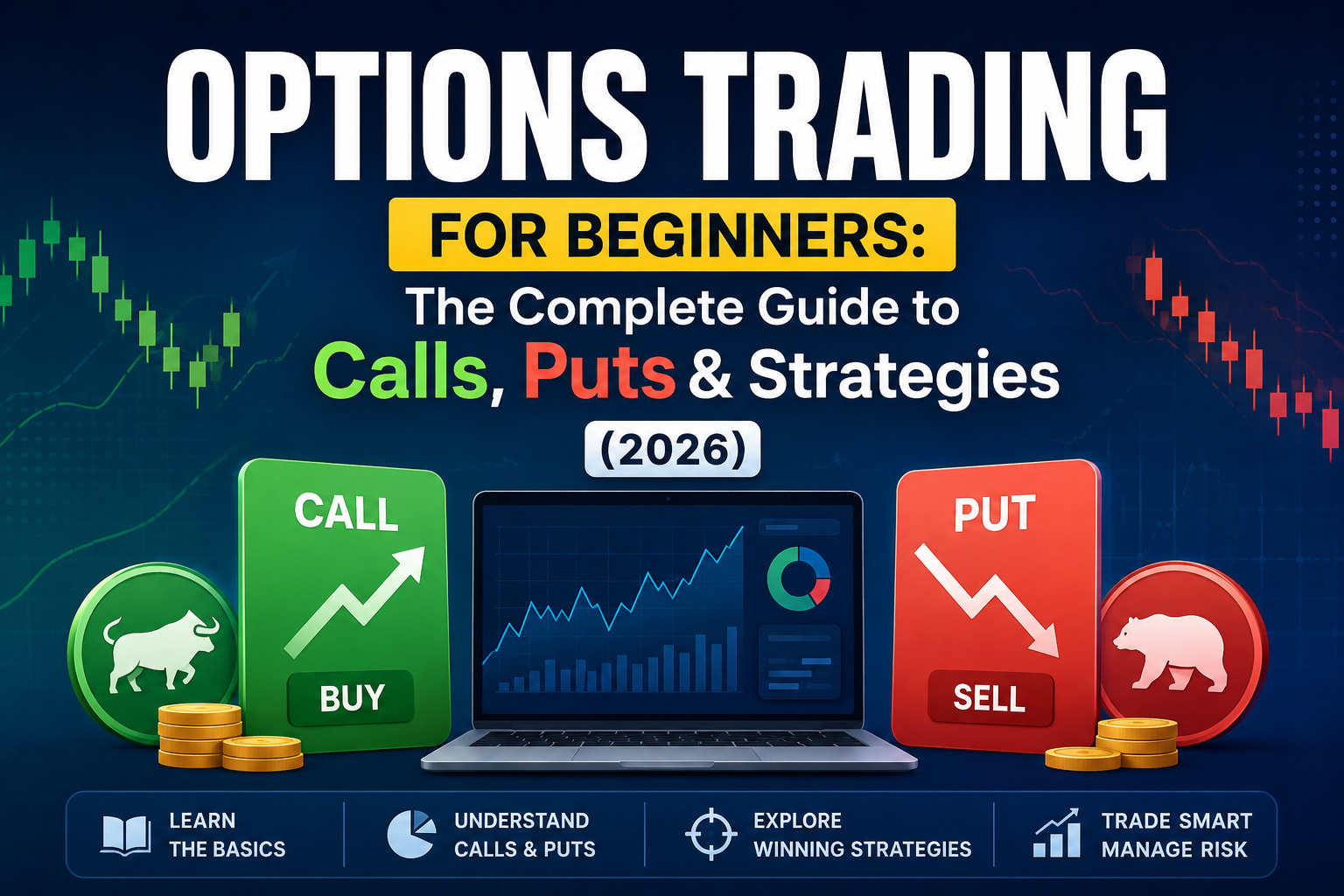
Options Trading for Beginners: The Complete Guide to Calls, Puts & Strategies (2026)
If you have ever watched the stock market news and heard words like "call option," "put option," or "options chain" and felt lost, this guide is for you. We are going to explain options trading in easy English, step by step, with real examples.
By the end of this blog, you will understand what options are, how call and put options work, the most popular options trading strategies, the risks involved, and how you can start learning options trading the right way, with structured courses like the Futures & Options Trading Strategies course at Empirical F&M Academy.
What Is Options Trading?
Options trading is buying or selling a contract that gives you the right, but not the obligation, to buy or sell a stock (or index) at a fixed price before a fixed date. You pay a small amount called a "premium" to hold this right. If the market moves in your favor, you profit. If it doesn't, your loss is usually limited to the premium you paid.
This short definition is the core of everything below — so keep it in mind as we go deeper.
Table of Contents
- What Are Options in the Stock Market?
- Call Options vs Put Options — Explained Simply
- Key Options Trading Terms Every Beginner Should Know
- How Does Options Trading Actually Work? (Example)
- Best Options Trading Strategies for Beginners
- Options Trading vs Futures Trading vs Intraday Trading
- Risks of Options Trading (And How to Manage Them)
- How to Start Options Trading Step by Step
- Common Mistakes New Options Traders Make
- Frequently Asked Questions (FAQs)
1. What Are Options in the Stock Market?
An option is a financial contract between two parties — a buyer and a seller. It is based on an underlying asset, which could be a stock (like Reliance or TCS) or an index (like Nifty 50 or Bank Nifty).
Think of it like booking a hotel room in advance. You pay a small "booking amount" to lock in today's price. If you decide not to travel, you lose only the booking amount — not the full hotel cost. Options work the same way. You pay a small premium to "lock in" a price, and later you decide whether you want to use that right or let it go.
There are two types of options: call options and put options. Let's break both down in plain language.
2. Call Options vs Put Options
This is the single most searched topic in options trading for beginners, so let's make it crystal clear.
What Is a Call Option?
A call option gives the buyer the right to buy a stock at a fixed price (called the "strike price") before the contract expires. You buy a call option when you believe the price of a stock or index will go up.
Example: Suppose Nifty is trading at 24,000. You buy a call option with a strike price of 24,200, paying a premium of ₹100. If Nifty rises to 24,500 before expiry, your option becomes valuable, and you profit from the difference (minus the premium you paid). If Nifty stays below 24,200, you simply lose the ₹100 premium nothing more.
What Is a Put Option?
A put option gives the buyer the right to sell a stock at a fixed strike price before expiry. You buy a put option when you believe the price will go down.
Example: If you buy a Nifty put option with a strike price of 24,000 for a premium of ₹90, and Nifty falls to 23,700, your put option gains value because you have the right to "sell" at a higher price than the market. If Nifty instead rises, you lose only the ₹90 premium.
Simple Summary Table
|
Option Type |
You Expect |
Right You Get |
Maximum Loss (as buyer) |
|
Call Option |
Price to go UP |
Right to buy at strike price |
Premium paid |
|
Put Option |
Price to go DOWN |
Right to sell at strike price |
Premium paid |
This is the foundation of call and put options, and every strategy you learn later is built on top of this simple idea.
3. Key Options Trading Terms Every Beginner Should Know
Before moving to strategies, learn these basic terms — they will make everything else easier to follow:
- Strike Price – The fixed price at which the option can be exercised.
- Premium – The price you pay to buy an option contract.
- Expiry Date – The date the option contract ends. In India, weekly and monthly expiries are common for index options.
- In the Money (ITM) – When exercising the option would be profitable.
- Out of the Money (OTM) – When exercising the option would not be profitable right now.
- Options Chain – A table showing all available strike prices, premiums, and expiry dates for a stock or index.
- Lot Size – Options are traded in fixed lot sizes, not single shares.
- Open Interest (OI) – The total number of outstanding option contracts, used to gauge market sentiment.
If some of these still feel new, that's completely normal — most beginners need structured practice to really understand them, which is exactly what a guided Trade Smart Using Futures and Options course is designed for.
4. How Does Options Trading Actually Work? (Example)
Let's walk through a full, realistic example so the concept fully sinks in.
Imagine Bank Nifty is trading at 51,000. You believe it will rise in the next few days due to positive banking sector news. You decide to buy a call option:
- Strike Price: 51,200
- Premium: ₹150 per share
- Lot Size: 15
Your total cost = ₹150 × 15 = ₹2,250
If Bank Nifty rises to 51,600 before expiry, the value of your call option increases — let's say the premium rises to ₹450. You can sell the option and pocket the difference: (₹450 − ₹150) × 15 = ₹4,500 profit.
If Bank Nifty instead falls or stays flat, your call option may expire worthless, and you lose the ₹2,250 premium. That is the maximum you can lose as a buyer — this is why many beginners start with buying options rather than selling them, since the risk is capped and clearly defined.
5. Best Options Trading Strategies for Beginners
Once you understand calls and puts, you can combine them into options trading strategies that manage risk and target specific market conditions. Here are the most beginner-friendly ones:
a) Covered Call
You hold a stock you already own and sell a call option against it to earn extra premium income. This works well in a sideways or mildly bullish market.
b) Protective Put
You hold a stock and buy a put option to protect against a price fall — like buying insurance for your portfolio.
c) Long Straddle
You buy both a call and a put at the same strike price, expecting a big price move but unsure of the direction — commonly used around big news events or earnings.
d) Bull Call Spread
You buy a call option and simultaneously sell another call at a higher strike price, reducing your cost while capping your maximum profit. This is a lower-risk way to trade a bullish view.
e) Bear Put Spread
The opposite of a bull call spread — used when you expect a moderate fall in price, while limiting both risk and cost.
These strategies form the core of most advanced options trading strategies taught in professional courses, such as the Advanced Futures & Options program and the Futures & Options Trading Strategies course offered by Empirical F&M Academy.
6. Options Trading vs Futures Trading vs Intraday Trading
A common question beginners search for is how options trading compares to other trading styles. Here's a simple comparison:
|
Feature |
Options Trading |
Futures Trading |
Intraday Trading |
|
Obligation |
No obligation for buyer |
Obligation for both parties |
Depends on strategy used |
|
Risk (as buyer) |
Limited to premium |
Potentially unlimited |
Can be high, managed with stop-loss |
|
Capital Required |
Relatively lower (premium only) |
Higher (margin-based) |
Varies |
|
Best For |
Hedging, directional bets, income strategies |
Directional bets, hedging |
Quick, same-day price movements |
If you are also curious about short-term trading styles, this comparison of Swing Trading vs Intraday Trading explains which approach suits different types of traders. And if you want to explore fast-paced, same-day trading separately from options, our detailed guide on the Best Intraday Trading Course Online is a great next read.
7. Risks of Options Trading (And How to Manage Them)
Options trading can be rewarding, but it comes with real risks, especially if you don't understand the mechanics well:
- Time Decay (Theta): Options lose value as expiry approaches, even if the stock price doesn't move much.
- Volatility Risk: Sudden changes in market volatility can affect option premiums significantly.
- Unlimited Risk for Sellers: While option buyers have limited risk, option sellers can face large, even unlimited, losses if the market moves against them sharply.
- Overleveraging: Because options require lower capital, beginners often take oversized positions, increasing risk.
How to manage these risks:
- Never risk more than a small percentage of your capital on a single trade.
- Understand the "Greeks" (Delta, Theta, Vega, Gamma) before trading actively.
- Practice with a demo or simulated account before using real money.
- Learn under structured guidance rather than relying only on YouTube videos or tips from friends.
This is exactly the gap that a proper stock market course fills — moving you from guesswork to a rule-based trading approach.
8. How to Start Options Trading Step by Step
Here is a simple step-by-step roadmap for beginners:
- Open a Demat and Trading Account with a registered broker.
- Learn the basics of the stock market, technical analysis, and options terminology.
- Understand the options chain and how premiums are priced.
- Start small — trade with an amount you are fully prepared to lose while learning.
- Use a trading journal to track every trade and learn from mistakes.
- Get structured training from a reliable stock market institute instead of learning only through trial and error.
- Practice risk management on every single trade, without exceptions.
If you want a faster, more reliable path, learning from experienced mentors through a proper Futures & Options Trading Strategies course can save you years of costly trial and error. You can also explore the complete list of share market and finance courses available for different experience levels.
9. Common Mistakes New Options Traders Make
- Buying deep out-of-the-money options because they are "cheap," without understanding the low probability of profit.
- Ignoring time decay and holding losing positions till expiry.
- Trading options purely based on social media tips or hype.
- Not using stop-losses.
- Trading with money that is meant for essential expenses.
- Jumping into complex strategies before mastering the basics of calls and puts.
Avoiding these mistakes is often more important than finding the "perfect strategy." A solid foundation, built through courses like Technical Analysis combined with Fundamental Analysis, helps traders make informed decisions instead of emotional ones.
10. Frequently Asked Questions (FAQs)
Q1. Is options trading good for beginners?
Yes, if approached carefully. Options trading offers a way to participate in the market with limited, defined risk (as a buyer), but beginners should learn the fundamentals first before trading with real capital.
Q2. How much money do I need to start options trading?
You can start with a relatively small amount since options are priced based on premiums, not the full stock value. However, the exact amount depends on the lot size and premium of the option you choose.
Q3. Can I lose more money than I invest in options trading?
As an option buyer, your maximum loss is limited to the premium you paid. As an option seller (writer), losses can be significantly larger and are not capped in the same way, which is why selling options requires more experience and margin.
Q4. What is the difference between options and futures trading?
In futures trading, both the buyer and seller are obligated to complete the transaction. In options trading, only the seller is obligated; the buyer has the right, not the obligation, to exercise the contract.
Q5. What is the best way to learn options trading in India?
A structured, mentor-led course such as the Futures & Options Trading Strategies program at Empirical F&M Academy combined with real practice and risk management is generally the most reliable path, rather than learning only from scattered online videos.
Q6. Are options trading strategies suitable for part-time traders?
Yes. Certain strategies, like covered calls and protective puts, are designed for investors who don't want to monitor the market constantly and prefer a more measured, less time-intensive approach.
Final Thoughts
Options trading is not about luck; it's about understanding structure, probability, and risk. Once you clearly understand call and put options, practice with small amounts, and follow disciplined risk management, options trading can become a powerful tool in your overall trading and investing strategy.
If you're serious about mastering this skill the right way, explore the Futures & Options Trading Strategies course or browse the complete range of stock market courses at Empirical F&M Academy. You can also check out more beginner-friendly guides on the Empirical Academy blog, or reach out directly through their contact page to talk to a course advisor.
Disclaimer: This blog is for educational purposes only and does not constitute investment advice. Options trading involves risk, including the potential loss of capital. Please consult a certified financial advisor and practice proper risk management before trading with real money.
Latest Course

Latest posts




Copyright © By Empirical F&M Academy. Design & Developed by Techno Duniya