
Financial Modelling and Valuation Course: Everything You Need to Know
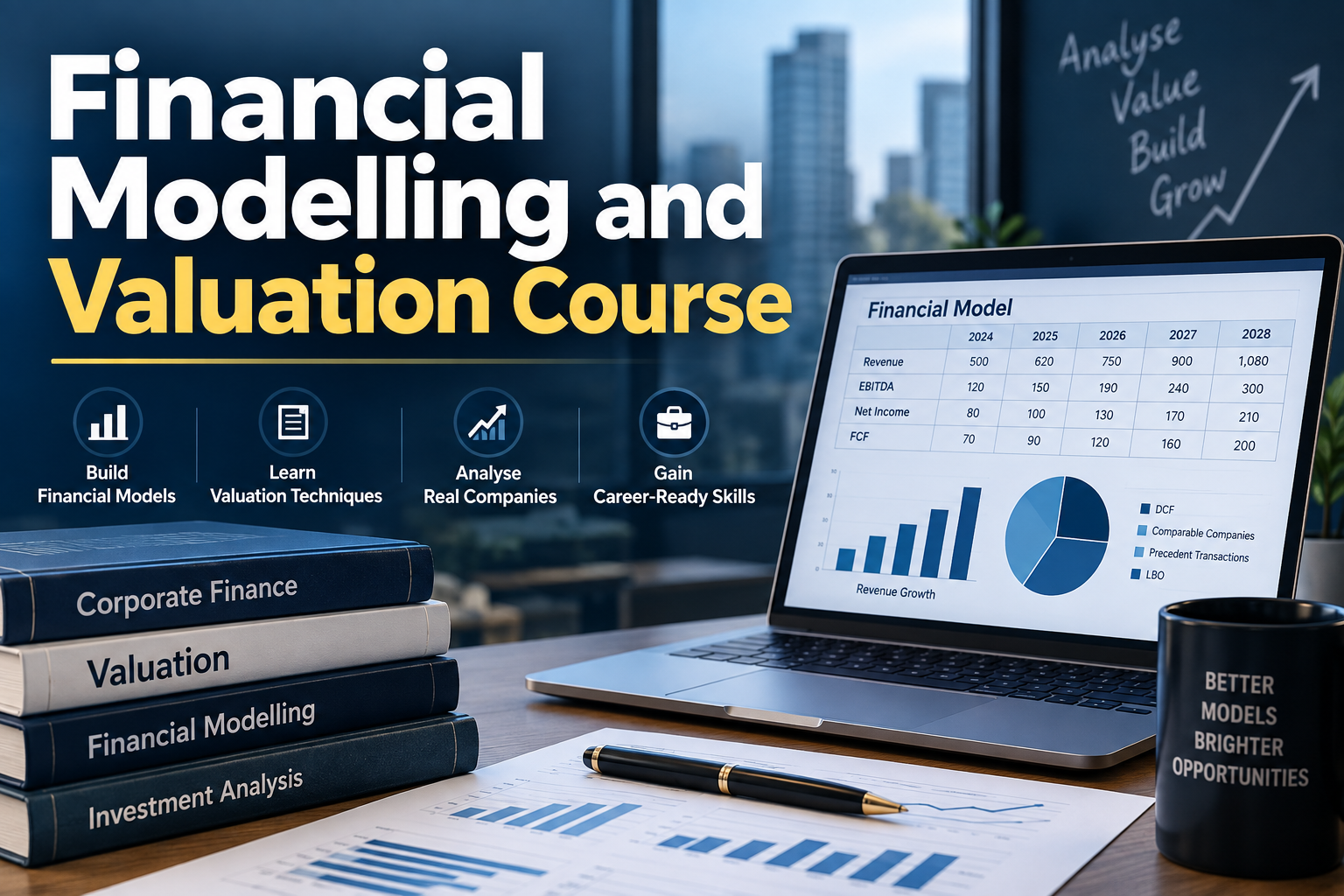
Financial Modelling and Valuation Course: Everything You Need to Know
If you have ever looked at a company's balance sheet and wondered how analysts arrive at a "target price," or how investment bankers decide what a business is really worth, the answer almost always comes down to one skill: financial modelling. It is the language of corporate finance, and it is one of the most in-demand capabilities for anyone who wants to build a serious career in equity research, investment banking, private equity, or corporate strategy.
At Empirical F&M Academy, our Financial Modelling and Valuation course is designed to take you from the basics of financial statements to building a fully functional, three-statement financial model in Excel — the same kind of model used by analysts on the job.
What Is Financial Modelling and Valuation?
Financial modelling is the process of building a structured representation of a company's financial performance, usually in Excel, that links its Income Statement, Cash Flow Statement, and Balance Sheet together. A well-built model lets you forecast how a business will perform under different assumptions — revenue growth, margins, capital expenditure, working capital changes — and see how those assumptions flow through to profitability, cash generation, and overall financial health.
Valuation, on the other hand, is what you do with that model once it's built. It's the process of estimating what a company or asset is actually worth, based on its expected future cash flows, the risks involved, and its growth potential. Together, financial modelling and valuation form the analytical backbone of nearly every major decision in corporate finance — from IPO pricing to M&A deals to simple stock-picking.
Because these two skills go hand in hand, most well-structured training programs, including ours, teach them as a single, connected discipline rather than two separate topics.
What You'll Learn in the Course
Our Financial Modelling and Valuation course is built around a practical, hands-on approach rather than passive lecture-watching. The curriculum covers:
- Understanding financial statements — how the Income Statement, Cash Flow Statement, and Balance Sheet are structured and how they connect to one another.
- Building forecast assumptions — learning how to translate business drivers (like sales growth, cost structure, and capex plans) into usable forecasting inputs.
- Constructing a full three-statement model — modelling out the P&L, cash flow, and balance sheet within Excel so they update dynamically together.
- Core valuation techniques — including Discounted Cash Flow (DCF) analysis and relative valuation multiples like EV/EBITDA, which help translate a model's outputs into an actual estimate of value.
- A student-led case study — you'll apply everything you've learned to a real company, building your own model from scratch rather than just following along with a template.
By the end of the course, you should be comfortable creating a financial model independently and reviewing or auditing models built by others — a skill that's directly transferable to real analyst roles.
Who Should Take This Course
This course works well for a wide range of learners:
- Students and MBA aspirants who want a practical edge before entering finance interviews
- Working professionals in accounting, banking, or corporate finance who want to formalize their Excel and modelling skills
- Traders and investors who want to move beyond technical charts and understand the fundamental value of a business
- Anyone exploring careers in equity research, investment banking, or corporate finance
A basic understanding of finance and comfort working in Excel is all you need to get started — the course itself builds up your knowledge from there.
How This Course Fits Into a Broader Learning Path
Financial modelling doesn't exist in isolation — it works best alongside a solid foundation in reading financial statements and researching companies. If you're just starting out, our Fundamental Analysis course is a good place to build that base before diving into modelling.
If you've already covered the fundamentals and want a deeper, more advanced modelling and valuation track, take a look at our Mastering Financial Modelling, Analysis & Valuation program, which goes further into applied valuation and analytical case studies.
For those specifically interested in the research side of the business — writing investment theses and evaluating companies for a living — our Equity Research and Valuation course pairs naturally with financial modelling, since strong research is built on strong models.
And if you want to sharpen your understanding of financial statements themselves before or alongside modelling, our Financial Statement Analysis course is a focused option worth exploring.
Why Learn Financial Modelling and Valuation With Us
Empirical F&M Academy has trained over 50,000 participants across a wide range of finance and stock market courses, in partnership with NSE Academy on several certification tracks. Here's what sets our approach apart:
- Practical, case-study-driven learning. You won't just watch someone else build a model — you'll build your own, from raw assumptions to a finished output.
- Experienced faculty. Our instructors include CAs, CFAs, and professionals who have worked directly in equity research, corporate advisory, and financial markets.
- Certification that counts. On completion, you receive a certificate that can strengthen your resume for roles in investment banking, equity research, and corporate finance.
- Flexible learning formats. Choose live interactive sessions or revisit recorded content at your own pace, with lifetime access to course material.
You can browse our full catalog of finance and stock market programs under Empirical F&M Academy's course offerings to see how this course fits alongside our other analyst-track programs.
Final Thoughts
Financial modelling and valuation is one of those skills that pays off well beyond a single course — it changes how you read a company's numbers for the rest of your career. Whether your goal is to break into investment banking, sharpen your equity research skills, or simply make smarter investment decisions on your own portfolio, learning to build and interpret financial models is time well spent.
If you're ready to get started, you can explore the full course structure and enroll directly on our Financial Modelling and Valuation course page, or get in touch with our team if you'd like guidance on which program is the right fit for your goals.
Latest Course


Latest posts




Copyright © By Empirical F&M Academy. Design & Developed by Techno Duniya