
Why Retail Traders Lose Money in F&O in 2026
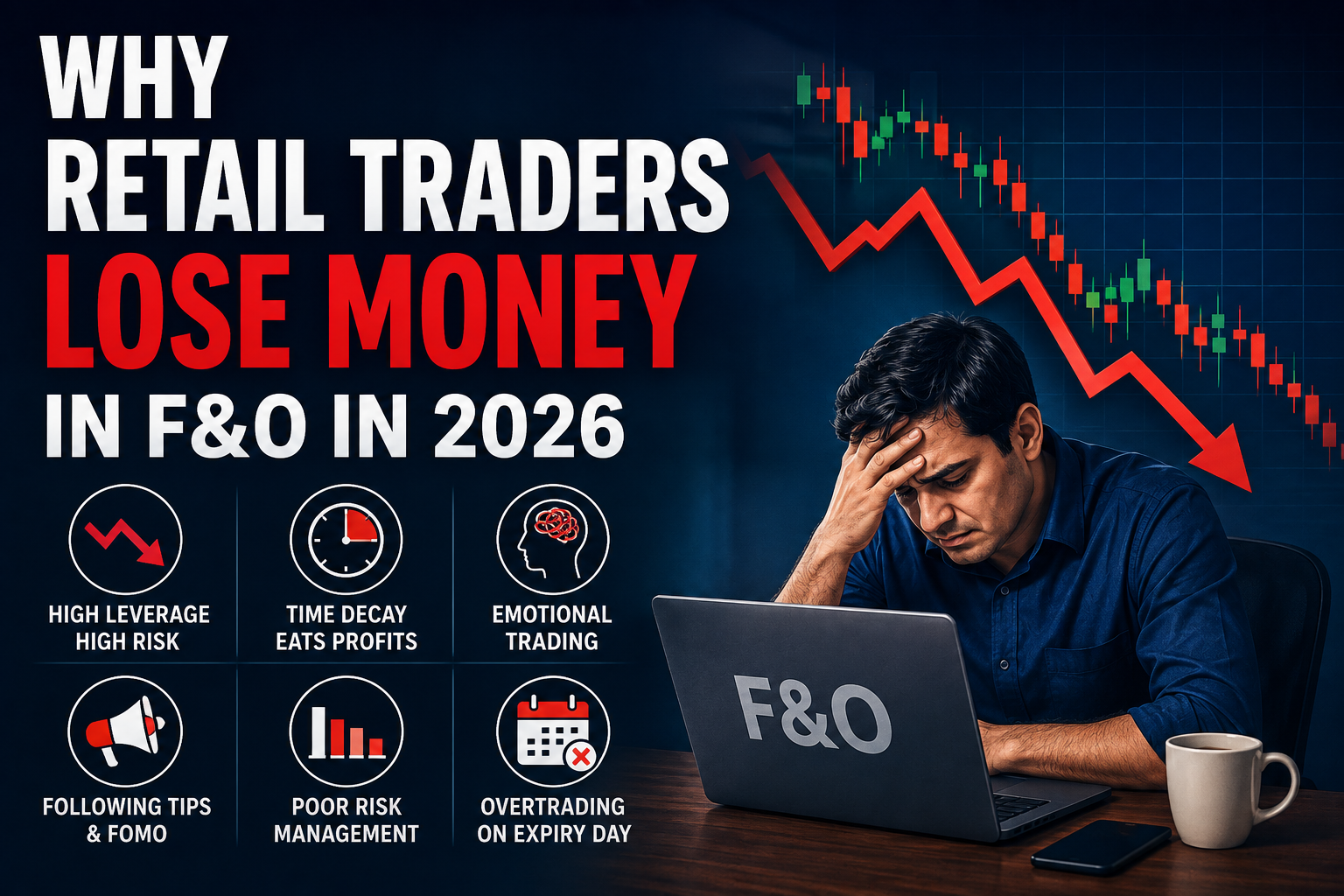
Why Retail Traders Lose Money in F&O in 2026
Futures and Options (F&O) trading looks exciting. You see people posting profit screenshots on social media, and it feels like easy money. But the real numbers tell a very different story.
According to SEBI's latest study on the F&O segment, nearly 9 in 10 retail traders in India's equity derivatives market lost money in FY26, with aggregate losses of around ₹91,685 crore. Even more telling, among traders who lost money for two consecutive years and kept trading anyway, roughly 90% went on to lose money again the following year.
So why does this keep happening, year after year, even as SEBI tightens the rules? Let's break it down in simple language.
1. Most Traders Don't Understand What They're Trading
F&O contracts are not like buying a stock. They involve leverage, expiry dates, and time decay. A lot of retail traders jump in after watching a YouTube video or a Telegram "tip," without understanding basics like strike price, premium, or margin.
If you're serious about trading F&O, it helps to actually learn the subject properly instead of guessing your way through it. A structured course like Trade Smart Using Future & Option covers exactly these fundamentals before you risk real money.
2. Options Buying Feels Cheap, But It's a Losing Habit
Buying options (especially weekly options close to expiry) is popular because the cost looks small, just a few thousand rupees. But time decay works against the buyer every single day. Most retail traders keep buying options hoping for a big move, and most of the time, the premium just decays to zero.
This is one of the biggest reasons behind the losses SEBI keeps reporting year after year.
3. Overtrading and Revenge Trading
After a loss, many traders try to "win it back" immediately with a bigger position. This is called revenge trading, and it's one of the fastest ways to blow up an account. Emotional decisions replace logical ones, and losses compound quickly.
Learning how professional traders manage risk and emotions is a core part of any good Intraday Trading Mastery program; it's not just about strategy, it's about discipline.
4. No Risk Management or Stop-Loss Discipline
A shocking number of retail traders don't use stop-losses at all, or they move their stop-loss further away when a trade goes against them, hoping the market will "come back." It rarely does in time.
Professional trading is built around position sizing and risk-per-trade rules, not hope.
5. High Transaction Costs Eat Into Profits
Every trade comes with brokerage, STT, exchange charges, GST, and stamp duty. For high-frequency traders, especially those doing multiple intraday F&O trades, these costs add up fast and quietly eat into whatever small profits are made. SEBI's studies have repeatedly flagged transaction costs as a major reason losses are larger than traders realize.
6. Trading Without a Tested Strategy
Many retail traders don't backtest anything. They enter trades based on a "gut feeling," a tip from a friend, or a chart pattern they half-remember. Without a tested, rule-based strategy, results are essentially random, and randomness, over time, tends to lose to transaction costs and slippage.
Courses like Advanced Futures & Options teach traders how to actually build and test a strategy before trading it live.
7. Competing Against Institutions and Algorithms
Retail traders aren't just competing against each other — they're competing against proprietary trading desks and algorithmic systems that react in milliseconds and have far more data, capital, and risk controls. It's an uneven playing field, and most retail traders don't realize how uneven it really is until they've lost money finding out.
8. Chasing Quick Money Instead of Building Skill
F&O trading is often marketed as a shortcut to wealth. In reality, it's a skill closer to a profession than a lottery ticket. Traders who treat it casually, without investing time in learning technical analysis, market structure, and risk management, are set up to lose.
If you want a proper foundation before you put real capital at risk, structured learning paths like Fundamental Analysis and Technical Analysis are a far better starting point than jumping straight into options buying.
The Bottom Line
The data is clear and consistent year after year: most retail traders lose money in F&O, and the losses are getting larger, not smaller, despite tighter regulations. The traders who do survive and profit treat it like a business: they study the market, manage risk strictly, and avoid emotional decisions.
If you're serious about trading F&O in 2026, the smartest first step isn't opening a trading app; it's building real knowledge first. You can explore structured, expert-led courses at Empirical F&M Academy to learn the fundamentals before you risk your capital.
This article is for educational purposes only and is not investment advice. Trading in F&O involves substantial risk of loss and is not suitable for all investors.
Latest Course

Latest posts




Copyright © By Empirical F&M Academy. Design & Developed by Techno Duniya